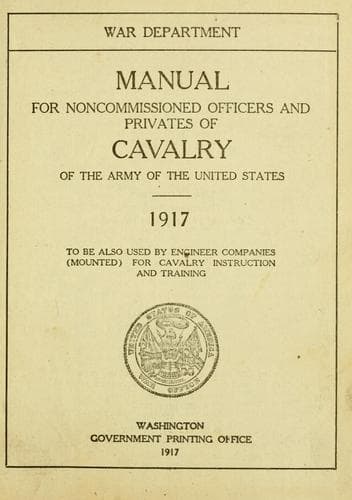
Manual for Noncommissioned Officers and Privates of Cavalry of the Army: of the United States 1917. To be also used by Engineer Companies (Mounted) for Cavalry Instruction and TrainingUnited States. War Department
History
Manual for Noncommissioned Officers and Privates of Cavalry of the Army: of the United States 1917. To be also used by Engineer Companies (Mounted) for Cavalry Instruction and Training
United States. War Department
United States. Army -- Handbooks, manuals, etc.
=Rivers.=--Direction; width, depth; kind of bottom, such as mud, sand,
rocky, etc.; banks, steep or gentle, open or wooded; rapidity of
current; variations in depth at different times as indicated by
driftwood and high-water marks; islands; heights in vicinity
commanding streams.
=Woods.=--Extent and shape; kind of trees; free from underbrush or
not; clearings, roads, swamps, ravines, etc.
=Telegraph lines.=--Number of wires, along roads or railroads,
stations, etc.
=Villages.=--Size, kind of houses, nature of streets, means of
defense, etc.
=Hills and ridges.=--Whether scopes are gentle or steep; whether top
is narrow or wide; whether ground is broken or smooth, wooded or
clear; whether difficult or easy to cross, etc.; whether commanded by
other hills.
=Defiles.=--Their direction, length, and width; whether surrounding
heights are passable for infantry and artillery: kind of country at
each opening of the defile, etc.
=Ravines, ditches, etc.=--Width and depth; banks, whether passable for
infantry, cavalry, and wagons; whether suitable for trenches, or for
movement of troops therein, etc.
In general, every soldier should be constantly on the lookout to
obtain information that might be of some military value. Remember that
information of the enemy and of the country is worthless unless made
known to the proper officials in time to be of use.
Every soldier should be able to find his way in a strange country;
should know how to use a compass; should know how to locate the North
Star; should be able to travel across country, keeping a given
direction, both by day and by night, and by observing landmarks he
should be able to return to the starting point either over the same
route or by a more circuitous one. This can easily be learned =by a
little practice=.
It adds a great deal to the value of a soldier if he knows how to use
a map to find his way. If he knows how to =make= a rough sketch of the
country showing the position of roads, streams, woods, railroads,
bridges, houses, villages, fields, fences, hills, etc., he has added
to his value as a soldier very much, indeed, because a rough sketch of
a country will give more and better information at a glance than can
be obtained by reading many pages of written description.
=Patrolling= is one of the most important duties a soldier can learn.
Any enlisted man who understands thoroughly his duties as a member of
a patrol will understand also most of his duties when with advance or
rear guards or when on outpost duty. Patrolling can not be learned
merely by reading books nor by work indoors. Thoroughness comes only
by actually going out in the country and acting as a patrol.
In carrying out this idea the following scheme is recommended:
Public-domain text, read in full here on John Shaqi.
Reviews
Reviews
No reviews yet
Be the first to share your thoughts on this work.
Elsewhere in the archive
Join the Discussion
Join the discussion
Sign in to leave a comment or review.
Sign InorCreate an account