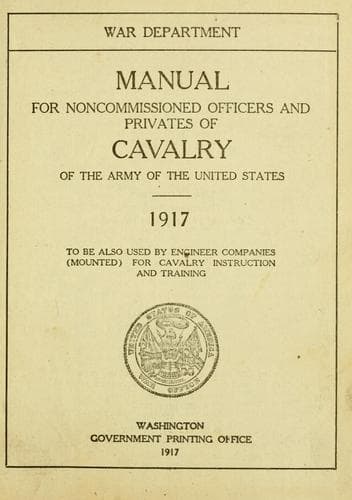
Manual for Noncommissioned Officers and Privates of Cavalry of the Army: of the United States 1917. To be also used by Engineer Companies (Mounted) for Cavalry Instruction and TrainingUnited States. War Department
History
Manual for Noncommissioned Officers and Privates of Cavalry of the Army: of the United States 1917. To be also used by Engineer Companies (Mounted) for Cavalry Instruction and Training
United States. War Department
United States. Army -- Handbooks, manuals, etc.
Let four or more men and a noncommissioned officer act as a patrol.
They assemble at a certain time, at a convenient point on some country
road. An officer, whom we will call Captain A, acts as the director;
the noncommissioned officer, whom we will call Sergeant B, acts as
patrol leader; and the others (Privates C, D, E, etc.) act as members
of Sergeant B's patrol.
Assume that the troop (squadron, etc.) has just made camp in this
vicinity and that the inhabitants are friendly (or hostile).
Captain A indicates to the rest of the men where the camp is situated
and points out where the various sentinels are posted. (This in itself
affords an opportunity for much discussion and for teaching many
valuable lessons.)
Captain A then calls up Sergeant B and tells him--
(_a_) Just what information Captain A has of the enemy, and also any
information of the country or of friendly troops in the vicinity that
might be of service to Sergeant B.
(_b_) How many men he shall take for the patrol (this is another
problem for Captain A to solve). Any men present not used as part of
the patrol ride along with Captain A as observers.
(_c_) How far he shall go and what country he shall cover with the
patrol.
(_d_) Just what information it is particularly desired he shall
obtain.
(_e_) Where he shall send his messages and when he shall return.
=Example 1=:
"Sergeant B, it has just been reported to me that a company of hostile
infantry was in camp last night at X, about 5 miles from here on this
road. Take 5 men and proceed toward X and find out whether the enemy
is still there, and if not, when he left and where he went. Send
messages to me here, and return by 8 o'clock this evening."
=Example 2=:
"Sergeant B, I think I heard the firing of field guns over in that
direction a short while ago. Take 6 men and proceed to that high hill
you see over there about 4 miles away. Send a message to me here when
you reach there. You may go farther if you then think it advisable,
but return before daylight. I desire particularly to know if there are
any hostile troops in this vicinity, especially artillery. I shall
send Sergeant X with 3 men to observe the country from that hill you
see over there farther to the south. He will remain there till dark.
Send messages to me here. If the troop is not here on your return you
will find a note for you underneath this rail."
=Example 3=:
Public-domain text, read in full here on John Shaqi.
Reviews
Reviews
No reviews yet
Be the first to share your thoughts on this work.
Elsewhere in the archive
Join the Discussion
Join the discussion
Sign in to leave a comment or review.
Sign InorCreate an account