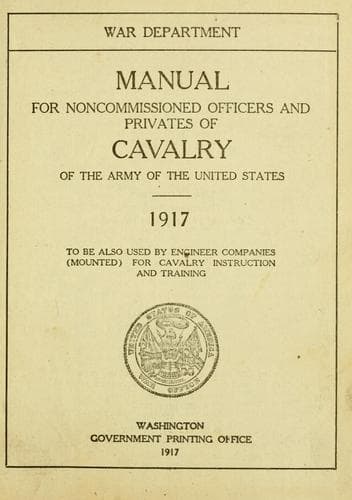
Manual for Noncommissioned Officers and Privates of Cavalry of the Army: of the United States 1917. To be also used by Engineer Companies (Mounted) for Cavalry Instruction and TrainingUnited States. War Department
History
Manual for Noncommissioned Officers and Privates of Cavalry of the Army: of the United States 1917. To be also used by Engineer Companies (Mounted) for Cavalry Instruction and Training
United States. War Department
United States. Army -- Handbooks, manuals, etc.
"Sergeant B, this friendly country boy has just reported that four
hostile cavalrymen stopped about half an hour ago at his father's
house, which he says is about 2 miles up this road. One of the men
seemed to be very sick. You will select eight men from your section
and endeavor to capture these men. If they have disappeared you will
reconnoiter in that vicinity until dark. This boy will accompany you
as a guide. He will ride Private X's horse. I desire particularly to
learn the position, strength, and composition of any hostile troops in
this vicinity. Send reports to me here. Return before daylight."
=Example 4=:
"Sergeant B, here is a map of the country in this vicinity on a scale
of 1 inch to the mile. Here is where we are camped [indicating
position on the map]. I have just learned that foraging parties of the
enemy are collecting supplies over here at X [indicating point on
map], which is 10 miles off in that direction [pointing across country
toward X]. It is reported that this bridge over this stream
[indicating same on the map], which is about 3 miles down this road
[indicating road and direction on the ground], has been destroyed. You
will take three men from your platoon and verify this report. You will
also reconnoiter the stream for a distance of 3 miles both above and
below the bridge for fords suitable for infantry. Messages will reach
me here. Return by 8 o'clock to-night."
Sergeant B then inspects his horses and men and gives them their
instructions. The patrol is then formed and moves out exactly as it
would under actual war conditions.
Captain A may halt (and assemble if desirable) the patrol at intervals
in order to discuss the formation used and the movement of any members
of the patrol, their route, use of cover, etc., with the reasons
therefor, and compare the same with suggested modifications of the
formations, etc. After the discussion, the patrol is again set in
motion. Captain A may accompany any part of the patrol. From time to
time he presents certain situations to some member of the patrol,
being very careful to assume only such situations as might naturally
occur.
Thus, take Example 1:
Captain A is with Sergeant B, who, with Private C, is marching along
the road as the point of the patrol. The other members of the patrol
are distributed to suit the nature of the country over which the
patrol is marching. The point has just reached a ridge beyond which
the country is open and cultivated for about half a mile. Beyond this
the road enters a woods. Captain A now says: "Sergeant B, from this
point you see two soldiers in khaki on the road there at the beginning
of that cornfield about 200 yards from the woods [points out same].
They are moving in this direction. About 200 yards to the right of
these and somewhat farther to their rear you see two more men moving
along that rail fence."
Public-domain text, read in full here on John Shaqi.
Reviews
Reviews
No reviews yet
Be the first to share your thoughts on this work.
Elsewhere in the archive
Join the Discussion
Join the discussion
Sign in to leave a comment or review.
Sign InorCreate an account