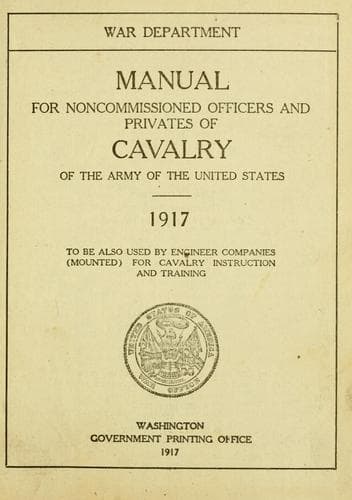
Manual for Noncommissioned Officers and Privates of Cavalry of the Army: of the United States 1917. To be also used by Engineer Companies (Mounted) for Cavalry Instruction and TrainingUnited States. War Department
History
Manual for Noncommissioned Officers and Privates of Cavalry of the Army: of the United States 1917. To be also used by Engineer Companies (Mounted) for Cavalry Instruction and Training
United States. War Department
United States. Army -- Handbooks, manuals, etc.
Sergeant B now does exactly as he would do in actual war. How does he
signal to his patrol? Does he assemble his men? If so, how and where?
Does he send a message back to camp; and if so, by whom, and is it
written or verbal? (If written, Sergeant B actually writes it and
delivers it to Private ----, with the necessary instructions. If
verbal, it is actually given to Private ---- with instructions.)
Captain A must in this case make notes of what the message was. In
either case, Private ---- ceases to be a member of the patrol and
joins Captain A as an observer. He should, however, at some later time
be required to repeat his message to Captain A, on the assumption that
he had reached camp with the same. The message, whether oral or
written, should be thoroughly analyzed and discussed. Was it proper to
send a message at this time? Does Sergeant B intend to remain in
observation; if so, how long? (Captain A can give such information
from time to time concerning the hostile patrol as Sergeant B might
reasonably be supposed to learn in view of his dispositions. In order
that Captain A may present natural assumptions, it is very essential
that in his own mind he should, at the outset, assume a situation for
the hostile forces and that he should consider himself as in command
of all hostile troops. In this particular case he should assume
himself to be in command of the hostile patrol, acting under certain
specified orders similar to examples given, and he should conduct this
patrol in his own mind in accordance with these orders, giving
Sergeant B only such information as he might reasonably be expected to
obtain in view of whatever action Sergeant B takes.) Will Sergeant B
attempt to capture this patrol? If so, how? Will he avoid fighting and
attempt to pass it unobserved; and if so, how and why?
In this manner the exercise is continued. Care must be taken not to
have the patrol leader or members state what they would do, but they
must actually do it. Explanations and discussions may take place
later.
In a similar manner the director may inform Sergeant B (or any member
of the patrol) that this hostile patrol is followed by a squad (on the
assumption that it is the leading unit of an advance guard), and the
exercise is then continued along these lines.
The following are examples of assumption that might be made and
carried out:
(_a_) That the patrol is unexpectedly fired upon.
(_b_) That one or more of the patrol is wounded.
(_c_) That a prisoner is captured (let an observer act as prisoner).
(_d_) That a friendly inhabitant gives certain information.
(_e_) That a dust cloud is seen in the distance over the trees.
(_f_) That a column of troops can be seen marching along a distant
road.
(_g_) That an abandoned camp is discovered and certain signs noted.
(_h_) That the patrol is attacked by a superior force and compelled to
scatter.
There is practically no end to the number of reasonable assumptions
that may be made.
Public-domain text, read in full here on John Shaqi.
Reviews
Reviews
No reviews yet
Be the first to share your thoughts on this work.
Elsewhere in the archive
Join the Discussion
Join the discussion
Sign in to leave a comment or review.
Sign InorCreate an account