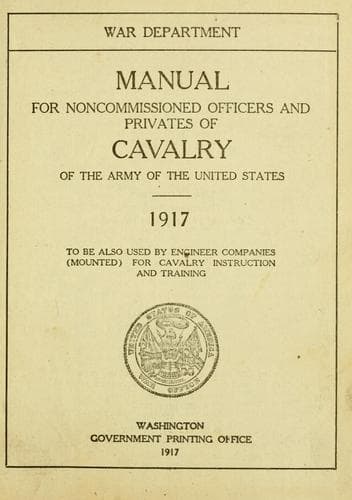
Manual for Noncommissioned Officers and Privates of Cavalry of the Army: of the United States 1917. To be also used by Engineer Companies (Mounted) for Cavalry Instruction and TrainingUnited States. War Department
History
Manual for Noncommissioned Officers and Privates of Cavalry of the Army: of the United States 1917. To be also used by Engineer Companies (Mounted) for Cavalry Instruction and Training
United States. War Department
United States. Army -- Handbooks, manuals, etc.
Troop officers may use this method of instructing noncommissioned
officers in patrolling, advance and rear guard duty, outposts, and in
squad leading, in writing messages, in selecting positions for
trenches, and in constructing and concealing same. This form of
instruction is called "a tactical ride or, if dismounted, a tactical
walk." It is very greatly used by all foreign armies. Exercises along
the same general lines are conducted for field and staff officers and
even general officers, and are called "tactical rides" and
"strategical rides," depending upon their object.
After some proficiency has been attained as a result of these tactical
rides, the greatest interest and enthusiasm can be awakened in this
work by sending out two patrols the same day, one to operate against
the other. Each should wear a distinctive uniform. The strength of
each patrol, its starting point, route to be followed, and its orders
should all be unknown to the other patrol. If blank ammunition is
used, an officer should supervise its issue and carefully inspect to
see that no man carries any ball cartridges. One umpire should
accompany the commander of each party. Each umpire should be fully
informed of the strength, orders, and route of both patrols. He must,
however, carefully avoid giving suggestions or offering any
information to the commander. Observers in these small maneuver
problems are generally in the way and none should be permitted to be
along.
These small maneuvers may be gradually developed by having one side
establish an outpost or fight a delaying action, etc.
It should always be remembered that there is no hard and fast rule
prescribing how a patrol of three, five, or any number of men should
march. The same is equally true of advance guards, and applies also to
the establishment of outposts. It is simply a question of common sense
based on military knowledge. Don't try to remember any diagrams in a
book. Think only of what you have been ordered to do and how best you
can handle your men to accomplish your mission, and at the same time
save the men and horses from any unnecessary hardships. Never use two
or more men to do what one can do just as well, and don't let your men
get beyond your control.
In addition to the signals prescribed in the Cavalry Drill
Regulations, the following should be clearly understood by the members
of a patrol:
Enemy in sight in small numbers, hold rifle above the head
horizontally; enemy in force, same proceeding, raising and lowering
the rifle several times; take cover, a downward motion of the hand.
Other signals may be agreed upon, but they must be familiar to the
men; complicated signals are avoided. Signals must be used cautiously
so as not to convey information to the enemy.
=Section 4. Advance guards.=
Public-domain text, read in full here on John Shaqi.
Reviews
Reviews
No reviews yet
Be the first to share your thoughts on this work.
Elsewhere in the archive
Join the Discussion
Join the discussion
Sign in to leave a comment or review.
Sign InorCreate an account