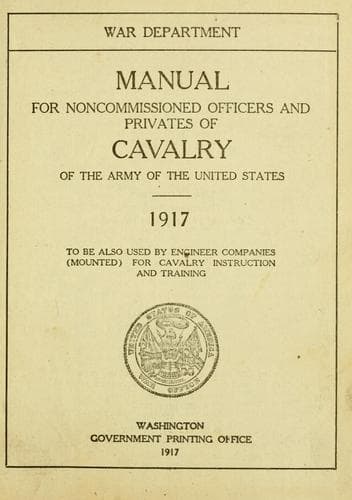
Manual for Noncommissioned Officers and Privates of Cavalry of the Army: of the United States 1917. To be also used by Engineer Companies (Mounted) for Cavalry Instruction and TrainingUnited States. War Department
History
Manual for Noncommissioned Officers and Privates of Cavalry of the Army: of the United States 1917. To be also used by Engineer Companies (Mounted) for Cavalry Instruction and Training
United States. War Department
United States. Army -- Handbooks, manuals, etc.
The advance guard is a detachment of the main body which precedes and
covers it on the march. The primary duty of an advance guard is to
insure the safe and uninterrupted march of the main body. Specifically
its duties are:
1. To guard against surprise and furnish information by
reconnoitering.
2. To push back small parties of the enemy and prevent their
observing, firing upon, or delaying the main body.
3. To check the enemy's advance in force long enough to permit the
main body to prepare for action.
4. When the enemy is encountered on the defensive, to seize a good
position and locate his lines, care being taken not to bring on a
general engagement unless the advance guard commander is empowered to
do so.
5. To remove obstacles, repair the road, and favor in every way the
steady, march of the column.
The strength of the advance guard will vary with the proximity of the
enemy and character of the country; for a regiment it will generally
consist of from two troops to a squadron, for a squadron of one troop;
for a troop of from a section to a platoon. The advance guard
commander is responsible for the proper performance of the duties with
which it is charged and for its conduct and formation.
The advance guard provides for its security and gains information by
throwing out to the front and flanks smaller bodies: Each part must
keep in touch with the unit from which it is sent out. An advance
guard is generally divided into a reserve and a support; where it
consists of less than a squadron, the reserve is generally omitted.
The support sends forward an advance party, which, in turn, sends
forward a point. In small advance guards the point precedes the
advance party about 350 yards, the advance party the support about 500
yards, and the support the main body about 600 yards. Where advance
guards are large enough to require a reserve these distances are
increased about one-fourth, the reserve following the support, the
main body following the reserve at a distance varying from 500 to 800
yards.
Public-domain text, read in full here on John Shaqi.
Reviews
Reviews
No reviews yet
Be the first to share your thoughts on this work.
Elsewhere in the archive
Join the Discussion
Join the discussion
Sign in to leave a comment or review.
Sign InorCreate an account