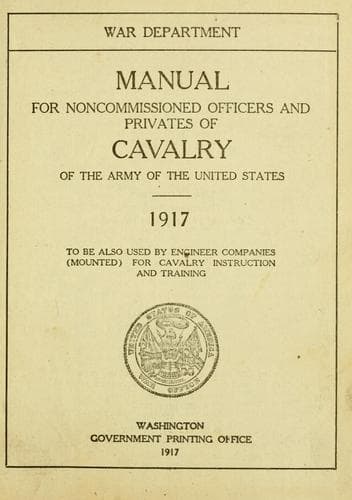
Manual for Noncommissioned Officers and Privates of Cavalry of the Army: of the United States 1917. To be also used by Engineer Companies (Mounted) for Cavalry Instruction and TrainingUnited States. War Department
History
Manual for Noncommissioned Officers and Privates of Cavalry of the Army: of the United States 1917. To be also used by Engineer Companies (Mounted) for Cavalry Instruction and Training
United States. War Department
United States. Army -- Handbooks, manuals, etc.
Unless the country to the flanks is distinctly visible from the roads
for a distance of what may be said to be effective rifle fire,
approximately 1,000 yards, flanking patrols of two or three men each
should be sent out from the advance party, and, when in proximity of
the enemy, in addition from the support. When the nature of the
country is such that patrols may move across country, without unduly
delaying the march these patrols should march at a distance of from
500 to 600 yards from the flank of the body from which detached. For
the examination of any object, such as a wood, buildings, etc.,
examining patrols should be sent out from the main body. The usual
method of protecting the flanks, particularly when the country is at
all cut up or difficult, is to send out patrols from time to time to
some point from which a good outlook can be obtained, or which will
afford protection to the enemy. These patrols remain in observation,
observer being dismounted, his horse held by another trooper until the
advance guard has passed, when they rejoin the nearest subdivision, as
quickly as possible working their way to that to which they belong
during the halts or by riding up the side of the road. By sending out
a succession of small patrols in this manner the flanks are protected.
Should the advance party become depleted, it must be reenforced from
the support.
A squadron acting as advance guard would have two or three troops in
reserve and one or two in support. The support would send forward as
advance party two platoons, the advance party in turn sending forward
as point one section. A troop acting as advance guard would have no
reserve and would send forward as advance party one platoon. All Of
the above may be changed as circumstances warrant.
Cases may arise when the best means of covering the head and flanks of
the column will be by a line of skirmishers extended at intervals of
from 5 to 50 yards, as, for instance, when passing through high corn,
underbrush, etc.
It must always be remembered that the principal duty of the advance
guard is to secure the uninterrupted march of the main body. If the
point is fired upon, it should at once deploy and endeavor to advance
fighting. The flankers should assist in this and endeavor to locate
the enemy's flank should there be such resistance that advance was
impossible. Each succeeding body should march promptly forward, and in
turn be placed in action, with the idea of clearing the way for the
advance of the main body. Should this be impossible, the commander of
the entire body must determine what measures he will take.
=Section 5. Rear guards.=
Public-domain text, read in full here on John Shaqi.
Reviews
Reviews
No reviews yet
Be the first to share your thoughts on this work.
Elsewhere in the archive
Join the Discussion
Join the discussion
Sign in to leave a comment or review.
Sign InorCreate an account