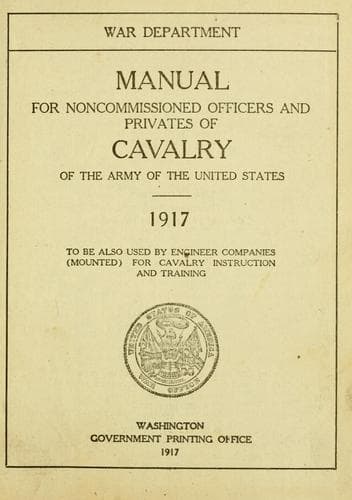
Manual for Noncommissioned Officers and Privates of Cavalry of the Army: of the United States 1917. To be also used by Engineer Companies (Mounted) for Cavalry Instruction and TrainingUnited States. War Department
History
Manual for Noncommissioned Officers and Privates of Cavalry of the Army: of the United States 1917. To be also used by Engineer Companies (Mounted) for Cavalry Instruction and Training
United States. War Department
United States. Army -- Handbooks, manuals, etc.
A rear guard is a detachment detailed to protect the main body from
attack in rear. Cavalry is an excellent arm for rear guard duty on
account of its mobility. While part of the cavalry is using dismounted
fire action, the other part may gallop back and take up a new
position. In a retreat it checks pursuit and enables the main body to
increase the distance between it and the enemy and to re-form if
disorganized. The general formation is that of an advance guard
reversed.
Its commander should take advantage of every favorable opportunity to
delay the pursuers by obstructing the road, or by taking up specially
favorable positions from which to force the enemy to deploy. In this
latter case care must be taken not to become so closely engaged as to
render withdrawal unnecessarily difficult. The position taken should
be selected with reference to ease of withdrawal and ability to bring
the enemy under fire at long range.
=Section 6. Flank guards.=
A flank guard is a detachment detailed to cover the flank of a column
marching past, or across the front of, an enemy. It may be placed in
position to protect the passage, or it may be so marched as to cover
the passage. The object of the flank guard is to hold the enemy in
check long enough to enable the main body to pass, or, like the
advance guard, to enable the main body to deploy. Like all other
detachments, it should be no larger than is necessary, and should not
be detailed except when its protection is required.
When a flank guard consists of a regiment or less, its distance from
the main body should not be much over 5 miles. Practicable
communication must exist between it and the main body. The flank guard
is marched as a separate command; that is, with advance or rear
guards, or both, as circumstances demand, and with patrolling on the
exposed flank.
=Section 7. Outposts.=
Troops not on the march provide for their security by outposts. The
general duties of an outpost are reconnoissance, observation, and
resistance.
The specific duties are:
1. To protect the main body, so that the troops may rest undisturbed.
2. In case of attack, to check the enemy long enough to enable the
main body to make the necessary dispositions.
During an advance the outposts are usually detailed from the advance
guard. During the retreat the outposts for the night usually forms
the rear guard the next day. If the command remains in bivouac, the
new outpost generally goes on duty at daybreak.
The vigilance of outpost troops must be unceasing, but they should
avoid bringing on combats or unnecessarily alarming the command.
Firing disturbs the rest of troops and, if frequently indulged in,
ceases to be a warning.
No trumpet signals except "to arms" or "to horse" are sounded, and all
unnecessary noises must be avoided.
Public-domain text, read in full here on John Shaqi.
Reviews
Reviews
No reviews yet
Be the first to share your thoughts on this work.
Elsewhere in the archive
Join the Discussion
Join the discussion
Sign in to leave a comment or review.
Sign InorCreate an account