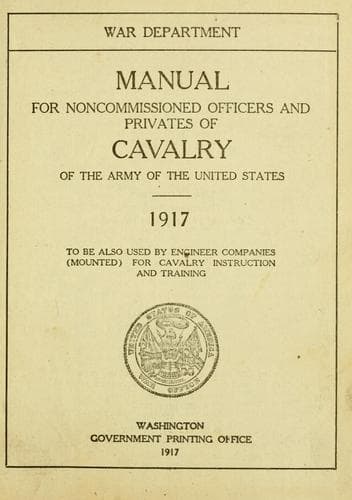
Manual for Noncommissioned Officers and Privates of Cavalry of the Army: of the United States 1917. To be also used by Engineer Companies (Mounted) for Cavalry Instruction and TrainingUnited States. War Department
History
Manual for Noncommissioned Officers and Privates of Cavalry of the Army: of the United States 1917. To be also used by Engineer Companies (Mounted) for Cavalry Instruction and Training
United States. War Department
United States. Army -- Handbooks, manuals, etc.
Soldiers should remember that only by acting vigorously on the
offensive can an army hope to gain the victory. The defensive may
delay or stop the enemy, but it can never destroy him. "Troops dig
because they are forced to halt; they do not halt to dig."
Trenches will frequently be constructed, without being used, and
soldiers must expect this as a feature of campaigning and accept
cheerfully what at times may appear as unnecessary labor.
When intrenching under fire cover is first secured in the lying
position, each man scooping but a depression for his body and throwing
the earth to the front. In this position no excavation can be
conveniently made for the legs, but if time permits the original
excavation is enlarged and deepened until it is possible to assume a
sitting position, with the legs crossed and the shoulder to the
parapet. In such apposition a man presents a smaller target to
shrapnel bullets than in the lying trench and can fire more
comfortably and with less exposure than in the kneeling trench. From
the sitting position the excavation may be continued until a standing
trench is secured.
The accompanying plate shows some of the more common forms of trenches
in profile. Figure 1 is the simplest form of standing trench. Figure 2
shows the same trench deepened in rear, so as to allow men to walk
along in the rear (deeper) portion of the trench without exposing
their heads above the parapet. Figure 3 shows a cover and firing
trench, with a chamber in which men can find shelter when under heavy
artillery fire. When the excavated earth is easily removed figure 4
shows a good profile. The enemy's infantry, as well as his artillery,
will generally have great difficulty in seeing this type of trench.
The mound or bank of earth thrown up for shelter in front of a trench
is called the =parapet=. It should be at least 30 inches thick on top,
and the front should slope gradually, as shown in the plate, so that
shells will tend to glance from it, rather than penetrate and explode.
The top should be covered with sod, grass, or leaves, so as to hide
the newly turned earth, which could be easily seen and aimed at by the
enemy. There should be no rocks, loose stones, or pebbles on top,
which might be struck by the bullets, splintering and flying, thus
adding greatly to the number of dangerous projectiles, and often
deflecting bullets downward into the trench. A stone wall is a very
dangerous thing to be behind in a fight.
The portion of the ground in rear of the parapet and between the
parapet and the trench not covered by the parapet is to rest the
elbows on when firing, the rifle being rested on top of the parapet.
Public-domain text, read in full here on John Shaqi.
Reviews
Reviews
No reviews yet
Be the first to share your thoughts on this work.
Elsewhere in the archive
Join the Discussion
Join the discussion
Sign in to leave a comment or review.
Sign InorCreate an account