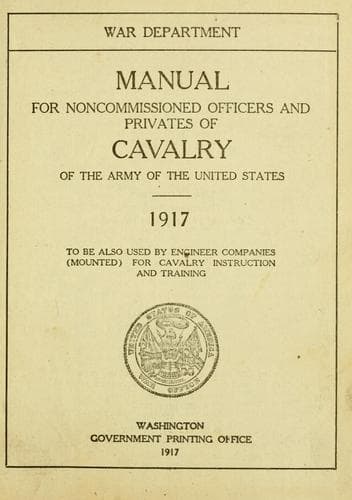
Manual for Noncommissioned Officers and Privates of Cavalry of the Army: of the United States 1917. To be also used by Engineer Companies (Mounted) for Cavalry Instruction and TrainingUnited States. War Department
History
Manual for Noncommissioned Officers and Privates of Cavalry of the Army: of the United States 1917. To be also used by Engineer Companies (Mounted) for Cavalry Instruction and Training
United States. War Department
United States. Army -- Handbooks, manuals, etc.
Other halts of 5 to 10 minutes should be made at hourly intervals,
and, if the march is to be prolonged into the afternoon, a longer halt
should be made at noon, when girths are loosened, bridles removed,
horses fed, and the men eat their lunches.
=An invariable rule on the march and in camp is to have all troopers
dismount promptly on halting; in other words, never to permit a man
to sit a moment in the saddle while his horse is standing still, and
under no circumstances to lounge in the saddle.=
=982.= =Watering=: On the march horses should be watered whenever
opportunity occurs, conforming as far as practicable to the rule of
watering before feeding and of removing the bit when by so doing the
horse can drink more freely, as when the stream or watering place is
shallow. Public watering troughs should ordinarily be avoided on
account of danger from infection. The use of buckets or of portable,
collapsible canvas watering troughs (articles of issue) will often
make watering places otherwise insufficient thoroughly satisfactory.
On the march and in camp watering is always done under supervision of
an officer.
=983.= =Feeding=: In time of peace when a regular supply of grain and
long forage can be counted on, effort should be made to follow, as far
as practicable, the routine to which horses have been accustomed in
garrison. In time of war regularity of supply of forage, and
especially of the long forage, can not be expected, and officers must
neglect no opportunity of anticipating the needs of their animals when
passing grain fields, pastures, or stacks of hay and other fodder. A
supply for the night can often be gathered and carried along on the
wagons or it may be tied up compactly with the lariat and carried on
the horse.
The trooper with habitual solicitude for his mount will, if permitted,
be prompt to remove the bits to let his horse graze (facing the wind
in hot weather) at every delay or check, and he will miss no chance to
pick up an extra feed of grain.
Public-domain text, read in full here on John Shaqi.
Reviews
Reviews
No reviews yet
Be the first to share your thoughts on this work.
Elsewhere in the archive
Join the Discussion
Join the discussion
Sign in to leave a comment or review.
Sign InorCreate an account