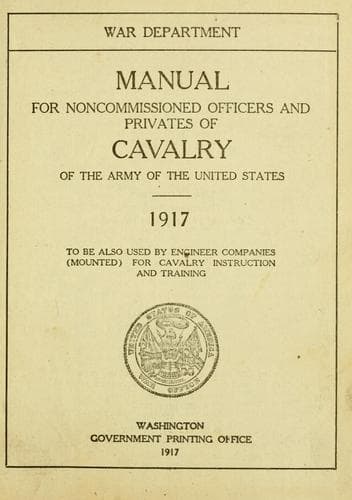
Manual for Noncommissioned Officers and Privates of Cavalry of the Army: of the United States 1917. To be also used by Engineer Companies (Mounted) for Cavalry Instruction and TrainingUnited States. War Department
History
Manual for Noncommissioned Officers and Privates of Cavalry of the Army: of the United States 1917. To be also used by Engineer Companies (Mounted) for Cavalry Instruction and Training
United States. War Department
United States. Army -- Handbooks, manuals, etc.
=984.= =Camps= (_see also_ =Care of Troops=, F. S. R.): The ground
being suitable, a troop encamps in line, with first sergeant's cook
and officers' tents on one flank, the men's sink on the other, and
with picket line 15 yards in front of and parallel to the men's tents,
the open ends of the tents toward the picket line. A squadron or
regiment encamps in column of troops as above, but with picket lines
on the flank of the column on the side opposite the cook and officers'
tents, each in prolongation of its own company street. Intervals and
distances should approximate those of the normal semipermanent camps
(F. S. R.), if space is available. For a shelter-tent camp in column
of troops with picket lines stretched between the rows of tents the
guidons which mark first sergeants' tents should not be less than 15
yards apart. The squadron or regiment may encamp in line similarly to
the troop if the ground is more favorable for such form of camp, but
ordinarily they encamp in column of troops with picket lines between
the rows of tents.
=985.= =On nearing the end of a day's march, the regimental commander
will send his adjutant and supply officer ahead to locate the camp and
provide for the arrival of the column=: On approaching the camping
place, squadron adjutants and the guidon of each troop will be
summoned by the colonel's bugler sounding =adjutant's call= followed
by guidons (or otherwise according to circumstances). At these calls
each squadron adjutant followed by the guidons of his squadron will
move rapidly to the front and will join the regimental adjutant, who
indicates to each the ground which his squadron is to occupy. If the
available ground is sufficient to encamp the entire regiment as
prescribed in the Field Service Regulations, the regimental adjutant
causes the guidons to be aligned and planted at the prescribed
intervals, thereby marking the first sergeant's tent on the flank of
each troop, otherwise each squadron adjutant has the guidons of his
squadron so placed on the ground allotted to his squadron as to
conform, as nearly as conditions will permit, to the normal camp,
having in view the comfort of horses and men and convenience to
supplies. The object in marking off the camp as prescribed, by
establishing the guidons before the arrival of the column, is to
relieve the horse of his rider and pack as soon as possible. To
further minimize delay, commanding officers, =unless under exceptional
circumstances=, will, immediately on reaching the ground, direct
majors to dismiss their squadrons and have their troop commanders
proceed directly to their guidons, dismount at once, and pitch camp.
The foregoing principles will also, in so far as applicable, be
enforced by commanders of all units smaller than the regiment.
Public-domain text, read in full here on John Shaqi.
Reviews
Reviews
No reviews yet
Be the first to share your thoughts on this work.
Elsewhere in the archive
Join the Discussion
Join the discussion
Sign in to leave a comment or review.
Sign InorCreate an account