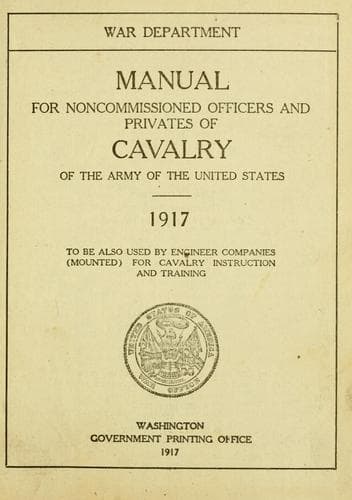
Manual for Noncommissioned Officers and Privates of Cavalry of the Army: of the United States 1917. To be also used by Engineer Companies (Mounted) for Cavalry Instruction and TrainingUnited States. War Department
History
Manual for Noncommissioned Officers and Privates of Cavalry of the Army: of the United States 1917. To be also used by Engineer Companies (Mounted) for Cavalry Instruction and Training
United States. War Department
United States. Army -- Handbooks, manuals, etc.
The regimental supply officer has the drivers of the baggage section
of the regimental train go direct to their proper troops and unhitch.
Ordinarily, for convenience in a one-night camp or bivouac the wagons
of the baggage section are left between the cook tents and the troop
officers' tents, the supply section being parked outside by itself.
After arrival at the camping place a guard is at once placed over the
source of supply of drinking water.
Before pitching tents the rifles are stacked, sabers, rolls, saddle
bags, and lariats removed from the saddles, girths loosened (the
saddles being left on until backs are cooled), and the horses either
linked by section, in circle (par. 428), or coupled head and tail
(par. 427), and a man detailed to watch them until tents are pitched.
After pitching tents, stacks are broken, rifles placed in the tents,
horses unsaddled, unbridled, and tied on the line or herded, saddles
placed in a row in front of the tents and saddle blankets spread on
them to dry, fuel secured, sinks dug, and other necessary preparations
made for the night. The use of saddle blankets as bedding by the men
will be permitted only under very exceptional conditions, and special
care must be exercised to keep them free from dirt and burs. During
evening stables, troop commanders, accompanied, if practicable, by a
veterinarian, inspect the backs and feet of their horses, and in the
morning they permit no trooper who is not specially authorized, to
saddle his horse before the call =boots and saddles=, or to mount
before the command for so doing.
=986.= =Herding=: In a hostile country camps should be selected, if
possible, where grazing is good and beyond rifle range of cover for an
enemy. Orders are issued as to places of assembly, and in each troop
men are detailed beforehand to go among the horses and quiet them in
case of a night alarm. In the event of a stampede, men should mount
the fastest animals within reach, ride ahead of the herd, and lead it
back to camp. Sometimes the sounding of stable and water call will
prevent or check a stampede.
In case it is necessary to graze the horses in an enemy's country,
they are sent out to herd under charge of an officer as soon as
possible after making camp, they being taken during daylight as far
away as is safe so as to keep the grass nearer camp for the night.
=987.= =Forced and night marches=: To conduct a rapid march of a
command of any magnitude successfully, horses must be =in condition=
(pars. 950, 959) and men must have been trained (par. 175); if either
is lacking, the daily marches at first must be short.
Public-domain text, read in full here on John Shaqi.
Reviews
Reviews
No reviews yet
Be the first to share your thoughts on this work.
Elsewhere in the archive
Join the Discussion
Join the discussion
Sign in to leave a comment or review.
Sign InorCreate an account