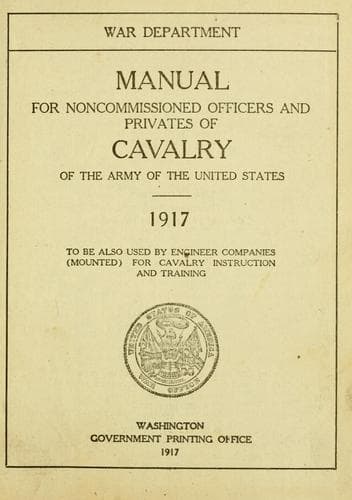
Manual for Noncommissioned Officers and Privates of Cavalry of the Army: of the United States 1917. To be also used by Engineer Companies (Mounted) for Cavalry Instruction and TrainingUnited States. War Department
History
Manual for Noncommissioned Officers and Privates of Cavalry of the Army: of the United States 1917. To be also used by Engineer Companies (Mounted) for Cavalry Instruction and Training
United States. War Department
United States. Army -- Handbooks, manuals, etc.
A night march, being slow and fatiguing to horses and men, is seldom
undertaken unless as a forced march to seize a position or to surprise
an enemy by attacking him at dawn. In a forced march frequently the
gait, if the footing is favorable, and always the number of hours in
the saddle, are increased. Under favorable conditions a rate of 50
miles in 24 hours for three or four days can be maintained. During
such a march, in addition to the usual hourly halts, a halt of 2 hours
is made toward the end of the first half of each day's march, during
which bits are removed, horses unsaddled, watered, fed, and their legs
hand rubbed; the rate should be about 5 miles an hour, exclusive of
halts.
Under very favorable conditions a single march of 100 miles can be
made in from 24 to 30 hours. During a march of this character, in
addition to the usual hourly halts, halts of 2 hours are made toward
the end of the first and second thirds of the march, during which bits
are removed, the horses unsaddled, watered, fed, and their legs hand
rubbed; the rate of march should be from 5 to 6 miles an hour,
exclusive of halts.
CHAPTER VIII.
TARGET PRACTICE.
=Section 1. Preliminary training in marksmanship.=
Effective rifle fire is generally what counts most in battle. To have
effective rifle fire, the men on the firing line must be able to HIT
what they are ordered to shoot at. There is no man who can not be
taught how to shoot. It is not necessary or even desirable to begin
instruction by firing on a rifle range. A perfectly green recruit who
has never fired a rifle may be made into a good shot by a little
instruction and some preliminary drills and exercises.
Before a man goes on the range to fire it is absolutely necessary that
he should know--
1. How to set the rear sight.
2. How to sight or aim.
3. How to squeeze the trigger.
4. How to hold the rifle in all positions.
If he does not know these things it is worse than useless for him to
fire. He will not improve; the more he shoots the worse he will shoot,
and it will become more difficult to teach him.
=Section 2. Sight adjustment.=
Men must be able to adjust their sights correctly and quickly. An
error in adjustment so small that one can scarcely see it on the sight
leaf is sufficient to cause a miss at an enemy at 500 yards and over.
Public-domain text, read in full here on John Shaqi.
Reviews
Reviews
No reviews yet
Be the first to share your thoughts on this work.
Elsewhere in the archive
Join the Discussion
Join the discussion
Sign in to leave a comment or review.
Sign InorCreate an account