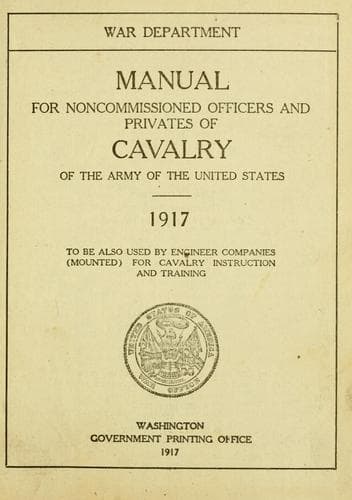
Manual for Noncommissioned Officers and Privates of Cavalry of the Army: of the United States 1917. To be also used by Engineer Companies (Mounted) for Cavalry Instruction and TrainingUnited States. War Department
History
Manual for Noncommissioned Officers and Privates of Cavalry of the Army: of the United States 1917. To be also used by Engineer Companies (Mounted) for Cavalry Instruction and Training
United States. War Department
United States. Army -- Handbooks, manuals, etc.
Notice your rear sight. When the leaf is laid down the =battle sight=
appears on top. This sight is set for 547 yards and is not adjustable.
When the leaf is raised four sights come into view. The extreme range
sight for 2,850 yards at the top of the leaf is seldom used. The open
sight at the upper edge of the drift slide is adjustable from 1,400 to
2,750 yards. To set it the upper edge of the slide is made to
correspond with the range reading on the leaf, and the slide is then
clamped with the slide screw. This sight also is seldom used. The open
sight at the bottom of the triangular opening in the drift slide is
adjustable from 100 to 2,450 yards. To set it the index line at the
lower corners of the triangle is set opposite the range graduation on
the leaf and the slide clamped. This and the peep sight just below it
are the sights most commonly used. To set the peep sight, the index
lines on either side of the peephole are set opposite the range
desired and the slide clamped.
Notice the scales for the various ranges on either side of the face of
the leaf. The odd-numbered hundreds of yards are on the right and the
even on the left. =The line below the number is the index line for
that range.= Thus to set the sight for 500 yards the index line of the
slide is brought in exact line with the line on the leaf below the
figure 5 and the slide clamped. To set for 550 yards the index lines
of the slide are set halfway between the index lines on the leaf below
the figure 5 on the right side and the figure 6 on the left side. Look
at your sight carefully when setting it and take great pains to get it
exact. An error in setting the width of one of the lines on the leaf
will cause an error of about 8 inches in where your bullet will strike
at 500 yards.
The =wind gauge= is adjusted by means of the windage screw at the
right front end of the base of the sight. Each graduation on the
wind-gauge scale is called a "point." For convenience in adjusting the
line of each third point on the scale is longer than the others. If
you turn the windage screw so that the movable base moves to the
right, you are taking right windage, which will cause your rifle to
shoot more to the right.
It is seldom that a rifle will shoot correctly to the point aimed at
at a given range with the sights adjusted exactly to the scale
graduations for that range. If your sight is not correctly adjusted
for your shooting and you wish to move it slightly to make it correct,
remember to =move it in the direction you wish your shot to hit=. If
you wish to shoot higher raise your sight. If to the right, move the
wind gauge to the right. Always move your sight the correct amount in
accordance with the following table:
=Section 3. Table of sight corrections.=
_Showing to what extent the point of impact is moved by a change of 25
yards in elevation or 1 point in windage._
Public-domain text, read in full here on John Shaqi.
Reviews
Reviews
No reviews yet
Be the first to share your thoughts on this work.
Elsewhere in the archive
Join the Discussion
Join the discussion
Sign in to leave a comment or review.
Sign InorCreate an account