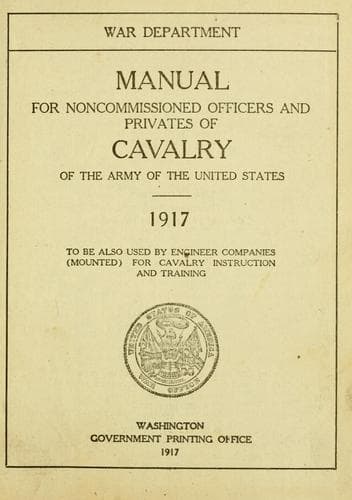
Manual for Noncommissioned Officers and Privates of Cavalry of the Army: of the United States 1917. To be also used by Engineer Companies (Mounted) for Cavalry Instruction and TrainingUnited States. War Department
History
Manual for Noncommissioned Officers and Privates of Cavalry of the Army: of the United States 1917. To be also used by Engineer Companies (Mounted) for Cavalry Instruction and Training
United States. War Department
United States. Army -- Handbooks, manuals, etc.
To simulate this type of fire mounted, the instructor places the squad
so that the simulated bull's-eyes are in turn, to the =RIGHT=, to the
=LEFT=, to the =RIGHT FRONT=, to the =LEFT FRONT=, to the =RIGHT
REAR=. With the squad in one of these positions, the instructor
cautions, "Position and aiming drill, mounted." At this caution the
right foot is carried 20 inches to the right and the left hand to the
position of the bridle hand (par. 145, Cavalry Drill Regulations).
The exercise is carried out as described for the exercise dismounted,
using the commands and means laid down in paragraph 141 for firing in
the several directions. The exercise is to be executed at will when
the squad has been sufficiently well instructed in detail.
When firing to the left the pistol hand will be about opposite the
left shoulder and the shoulders turned about 45° to the left; when
firing to the right rear the shoulders are turned about 45° to the
right.
When the soldier is proficient in these exercises with the pistol in
the right hand, they are repeated with the pistol in the left hand.
=Revolver or pistol range practice.=--The courses in range practice
are given in paragraphs 147 to 199, Small Arms Firing Manual, 1913.
CHAPTER IX.
EXTRACTS FROM MANUAL OF INTERIOR GUARD DUTY.
UNITED STATES ARMY, 1914.
[The numbers refer to paragraphs in the Manual.]
=Section 1. Introduction.=
=1.= Guards may be divided into four classes: Exterior guards,
interior guards, military police, and provost guards.
=2.= Exterior guards are used only in time of war. They belong to the
domain of tactics and are treated of in the Field Service Regulations
and in the drill regulations of the different arms of the service.
The purpose of exterior guards is to prevent surprise, to delay
attack, and otherwise to provide for the security of the main body.
On the march they take the form of advance guards, rear guards, and
flank guards. At a halt they consist of outposts.
=3.= Interior guards are used in camp or garrison to preserve order,
protect property, and to enforce police regulations. In time of war
such sentinels of an interior guard as may be necessary are placed
close in or about a camp, and normally there is an exterior guard
further out consisting of outposts. In time of peace the interior
guard is the only guard in a camp or garrison.
=4.= Military police differ somewhat from either of these classes.
(See Field Service Regulations.) They are used in time of war to guard
prisoners, to arrest stragglers and deserters, and to maintain order
and enforce police regulations in the rear of armies, along lines of
communication, and in the vicinity of large camps.
=5.= Provost guards are used in the absence of military police,
generally in conjunction with the civil authorities at or near large
posts or encampments, to preserve order among soldiers beyond the
interior guard.
=Section 2. Classification of interior guards.=
Public-domain text, read in full here on John Shaqi.
Reviews
Reviews
No reviews yet
Be the first to share your thoughts on this work.
Elsewhere in the archive
Join the Discussion
Join the discussion
Sign in to leave a comment or review.
Sign InorCreate an account