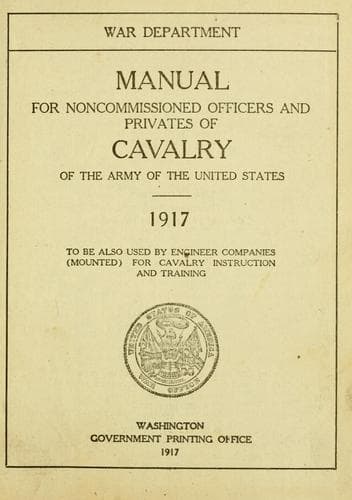
Manual for Noncommissioned Officers and Privates of Cavalry of the Army: of the United States 1917. To be also used by Engineer Companies (Mounted) for Cavalry Instruction and TrainingUnited States. War Department
History
Manual for Noncommissioned Officers and Privates of Cavalry of the Army: of the United States 1917. To be also used by Engineer Companies (Mounted) for Cavalry Instruction and Training
United States. War Department
United States. Army -- Handbooks, manuals, etc.
=6.= The various elements of an interior guard classified according to
their particular purposes and the manner in which they perform their
duties are as follows:
(_a_) The main guard.
(_b_) Special guards: Stable guards, park guards, prisoner guards,
herd guards, train guards, boat guards, watchmen, etc.
=Section 3. Details and rosters.=
=7.= At every military post, and in every regiment or separate command
in the field, an interior guard will be detailed and duly mounted.
It will consist of such number of officers and enlisted men as the
commanding officer may deem necessary, and will be commanded by the
senior officer or noncommissioned officer therewith, under the
supervision of the officer of the day or other officer detailed by the
commanding officer.
=8.= The system of sentinels on fixed posts is of value in discipline
and training because of the direct individual responsibility which is
imposed and required to be discharged in a definite and precise
manner. While the desirability of this type of duty is recognized, it
should only be put in practice to an extent sufficient to insure
thorough instruction in this method of performing guard duty, and
should not be the routine method of its performance. The usual guard
duty will be performed by watchmen, patrols, or such method as in the
opinion of the commanding officer may best secure results under the
particular local conditions.
=9.= At posts where there are less than three companies the main guard
and special guards may all be furnished by one company or by details
from each company. It is directed that whenever possible such guards
shall be furnished by a single company, for the reason that if guard
details are taken from each organization at a post of two companies,
troops, or batteries it will result in both being so reduced as to
seriously interfere with drill and instruction, whereas if details are
taken from only one the other is available for instruction at full
strength.
Where there are three or more companies, the main guard will, if
practicable, be furnished by a single company, and, as far as
practicable, the same organization will supply all details for that
day for special guard, overseer, and fatigue duty. In this case the
officer of the day and the officers of the guard, if there are any,
will, if practicable, be from the company furnishing the guard.
=10.= At a post or camp where the headquarters of more than one
regiment are stationed, or in the case of a small brigade in the
field, if but one guard be necessary for the whole command, the
details will be made from the headquarters of the command.
If formal guard mounting is to be held, the adjutant, sergeant major,
and band to attend guard mounting will be designated by the commanding
officer.
=11.= When a single organization furnishes the guard, a roster of
organizations will be kept by the sergeant major under the supervision
of the adjutant. (See Appendix B.)
Public-domain text, read in full here on John Shaqi.
Reviews
Reviews
No reviews yet
Be the first to share your thoughts on this work.
Elsewhere in the archive