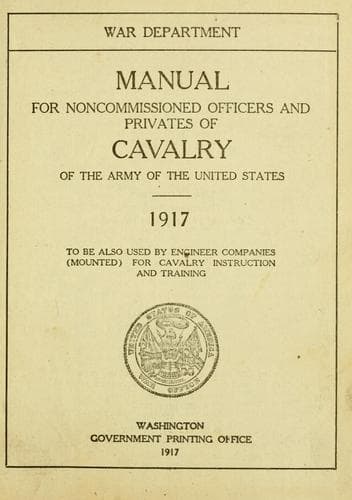
Manual for Noncommissioned Officers and Privates of Cavalry of the Army: of the United States 1917. To be also used by Engineer Companies (Mounted) for Cavalry Instruction and TrainingUnited States. War Department
History
Manual for Noncommissioned Officers and Privates of Cavalry of the Army: of the United States 1917. To be also used by Engineer Companies (Mounted) for Cavalry Instruction and Training
United States. War Department
United States. Army -- Handbooks, manuals, etc.
=12.= When the guard is detailed from several organizations, rosters
will be kept by the adjutant, of officers of the day and officers of
the guard by name; by the sergeant major under the supervision of the
adjutant, of sergeants, corporals, musicians, and privates of the
guard by number per organization; and by first sergeants, of
sergeants, corporals, musicians, and privates by name. (See Appendix
A.)
=13.= When organizations furnish their own stable, or stable and park
guards, credit will be given each for the number of enlisted men so
furnished as though they had been detailed for main guard.
=14.= Special guards, other than stable or park guards, will be
credited the same as for main guard, credited with fatigue duty,
carried on special duty, or credited as the commanding officer may
direct. (Pars. 6, 221, 247, and 300.)
=15.= Captains will supervise the keeping of company rosters and see
that all duties performed are duly credited. (See pars. 355-364, A.
R., for rules governing rosters, and Form 342, A. G. O., for
instructions as to how rosters should be kept.)
=16.= There will be an officer of the day with each guard, unless in
the opinion of the commanding officer the guard is so small that his
services are not needed. In this case an officer will be detailed to
supervise the command and instruction of the guard for such period as
the commanding officer may direct.
=17.= When more than one guard is required for a command, a field
officer of the day will be detailed, who will receive his orders from
the brigade or division commander, as the latter may direct. When
necessary captains may be placed on the roster for field officer of
the day.
=18.= The detail of officers of the guard will be limited to the
necessities of the service and efficient instruction; inexperienced
officers may be detailed as supernumerary officers of the guard for
purposes of instruction.
=19.= Officers serving on staff departments are, in the discretion of
the commanding officer, exempt from guard duty.
=20.= Guard details will, if practicable, be posted or published the
day preceding the beginning of the tour and officers notified
personally by a written order at the same time.
=21.= The strength of guards and the number of consecutive days for
which an organization furnishes the guard will be so regulated as to
insure privates of the main guard an interval of not less than five
days between tours.
When this is not otherwise practicable, extra and special duty men
will be detailed for night guard duty, still performing their daily
duties. When so detailed a roster will be kept by the adjutant showing
the duty performed by them.
=22.= The members of main guards and stable and park guards will
habitually be relieved every 24 hours. The length of the tour of
enlisted men detailed as special guards, other than stable or park
guards, will be so regulated as to permit of these men being held
accountable for a strict performance of their duty.
Public-domain text, read in full here on John Shaqi.
Reviews
Reviews
No reviews yet
Be the first to share your thoughts on this work.
Elsewhere in the archive
Join the Discussion
Join the discussion
Sign in to leave a comment or review.
Sign InorCreate an account