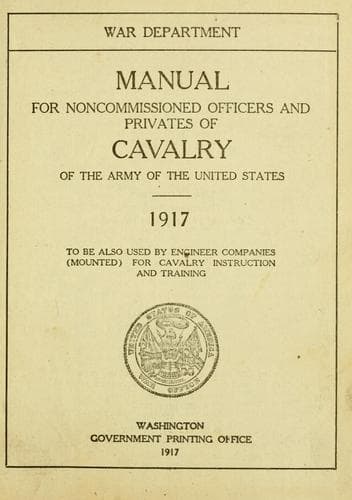
Manual for Noncommissioned Officers and Privates of Cavalry of the Army: of the United States 1917. To be also used by Engineer Companies (Mounted) for Cavalry Instruction and TrainingUnited States. War Department
History
Manual for Noncommissioned Officers and Privates of Cavalry of the Army: of the United States 1917. To be also used by Engineer Companies (Mounted) for Cavalry Instruction and Training
United States. War Department
United States. Army -- Handbooks, manuals, etc.
=23.= Should the officer of the day be notified that men are required
to fill vacancies in the guard, he will cause them to be supplied from
the organization to which the guard belongs. If none are available in
that organization, the adjutant will be notified and will cause them
to be supplied from the organization that is next for guard. (Par.
63.)
=24.= The adjutant will have posted on the bulletin board at his
office all data needed by company commanders in making details from
their companies.
At first sergeant's call first sergeants will go to headquarters and
take from the bulletin board all data necessary for making the details
required from their companies; these details will be made from their
company rosters.
=25.= In order to give ample notice, first sergeants will, when
practicable, publish at retreat and post on the company bulletin board
all details made from the company for duties to be performed.
=26.= Where rosters are required to be kept by this manual, all
details will be made by roster.
=Section 4. Commander of the guard.=
=41.= The commander of the guard is responsible for the instruction
and discipline of the guard. He will see that all of its members are
correctly instructed in their orders and duties and that they
understand and properly perform them. He will visit each relief at
least once while it is on post, and at least one of these visits will
be made between 12 o'clock midnight and daylight.
=42.= He receives and obeys the orders of the commanding officer and
the officer of the day, and reports to the latter without delay all
orders to the guard not received from the officer of the day; he
transmits to his successor all material instructions and information
relating to his duties.
=43.= He is responsible under the officer of the day for the general
safety of the post or camp as soon as the old guard marches away from
the guardhouse. In case of emergency, while both guards are at the
guardhouse, the senior commander of the two guards will be responsible
that the proper action is taken.
=44.= Officers of the guard will remain constantly with their guards,
except while visiting patrols or necessarily engaged elsewhere in the
performance of their duties. The commanding officer will allow a
reasonable time for meals.
=45.= A commander of a guard leaving his post for any purpose will
inform the next in command of his destination and probable time of
return.
=46.= Except in emergencies, the commander of the guard may divide the
night with the next in command, but retains his responsibility; the
one on watch must be constantly on the alert.
=47.= When any alarm is raised in camp or garrison, the guard will be
informed immediately. (Par. 234.) If the case be serious, the proper
call will be sounded, and the commander of the guard will cause the
commanding officer and the officer of the day to be at once notified.
Public-domain text, read in full here on John Shaqi.
Reviews
Reviews
No reviews yet
Be the first to share your thoughts on this work.
Elsewhere in the archive
Join the Discussion
Join the discussion
Sign in to leave a comment or review.
Sign InorCreate an account