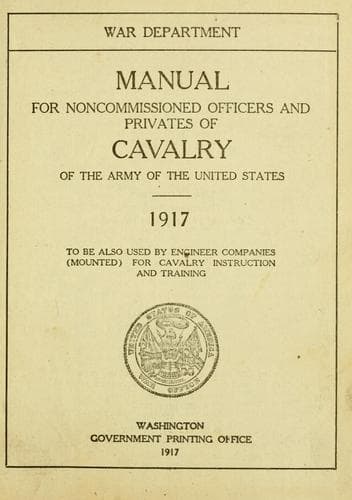
Manual for Noncommissioned Officers and Privates of Cavalry of the Army: of the United States 1917. To be also used by Engineer Companies (Mounted) for Cavalry Instruction and TrainingUnited States. War Department
History
Manual for Noncommissioned Officers and Privates of Cavalry of the Army: of the United States 1917. To be also used by Engineer Companies (Mounted) for Cavalry Instruction and Training
United States. War Department
United States. Army -- Handbooks, manuals, etc.
=48.= If a sentinel calls: "The guard," the commander of the guard
will at once send a patrol to the sentinel's post. If the danger be
great, in which case the sentinel will discharge his piece, the patrol
will be as strong as possible.
=49.= When practicable, there should always be an officer or
noncommissioned officer and two privates of the guard at the
guardhouse in addition to the sentinels there on post.
=50.= Between reveille and retreat, when the guard has been turned out
for any person entitled to the compliment (see pars. 222 and 224), the
commander of the guard, if an officer, will receive the report of the
sergeant, returning the salute of the latter with the right hand. He
will then draw his saber and place himself two paces in front of the
center of the guard. When the person for whom the guard has been
turned out approaches he faces his guard and commands: 1. =Present=,
2. =ARMS=; faces to the front and salutes. When his salute is
acknowledged he resumes the carry, faces about, and commands: 1.
=Order=, 2. =ARMS=; and faces to the front.
If it be an officer entitled to inspect the guard, after saluting and
before bringing his guard to an order, the officer of the guard
reports: "=Sir, all present or accounted for="; or "=Sir, (so-and-so)
is absent="; or, if the roll call has been omitted: "=Sir, the guard
is formed=," except that at guard mounting the commanders of the
guards present their guards and salute without making any report.
Between retreat and reveille the commander of the guard salutes and
reports, but does not bring the guard to a present.
=51.= To those entitled to have the guard turned out but not entitled
to inspect it no report will be made; nor will a report be made to any
officer unless he halts in front of the guard.
=52.= When a guard commanded by a noncommissioned officer is turned
out as a compliment or for inspection the noncommissioned officer,
standing at a right shoulder on the right of the right guide,
commands: 1. =Present=, 2. =ARMS.= He then executes the rifle salute.
If a report be also required, he will, after saluting and before
bringing his guard to an order, report as prescribed for the officer
of the guard. (Par. 50.)
=53.= When a guard is in line, not under inspection, and commanded by
an officer; the commander of the guard salutes his regimental,
battalion, and company commander by bringing the guard to attention
and saluting in person.
For all other officers, excepting those entitled to the compliment
from a guard (par. 224), the commander of the guard salutes in person,
but does not bring the guard to attention.
When commanded by a noncommissioned officer, the guard is brought to
attention in either case, and the noncommissioned officer salutes.
The commander of a guard exchanges salutes with the commanders of all
other bodies of troops; the guard is brought to attention during the
exchange.
Public-domain text, read in full here on John Shaqi.
Reviews
Reviews
No reviews yet
Be the first to share your thoughts on this work.
Elsewhere in the archive
Join the Discussion
Join the discussion
Sign in to leave a comment or review.
Sign InorCreate an account