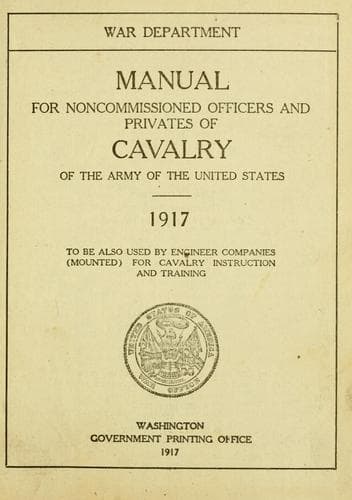
Manual for Noncommissioned Officers and Privates of Cavalry of the Army: of the United States 1917. To be also used by Engineer Companies (Mounted) for Cavalry Instruction and TrainingUnited States. War Department
History
Manual for Noncommissioned Officers and Privates of Cavalry of the Army: of the United States 1917. To be also used by Engineer Companies (Mounted) for Cavalry Instruction and Training
United States. War Department
United States. Army -- Handbooks, manuals, etc.
"Present arms" is executed by a guard only when it has turned out for
inspection or as a compliment, and at the ceremonies of guard mounting
and relieving the old guard.
=54.= In marching a guard or a detachment of a guard the principles of
paragraph 53 apply. "Eyes right" is executed only in the ceremonies of
guard mounting and relieving the old guard.
=55.= If a person entitled to the compliment, or the regimental,
battalion, or company commander, passes in rear of a guard, neither
the compliment nor the salute is given, but the guard is brought to
attention while such person is opposite the post of the commander.
After any person has received or declined the compliment, or received
the salute from the commander of the guard, official recognition of
his presence thereafter while he remains in the vicinity will be taken
by bringing the guard to attention.
=56.= The commander of the guard will inspect the guard at reveille
and retreat, and at such other times as may be necessary, to assure
himself that the men are in proper condition to perform their duties
and that their arms and equipments are in proper condition. For
inspection by other officers, he prepares the guard in each case as
directed by the inspecting officer.
=57.= The guard will not be paraded during ceremonies unless directed
by the commanding officer.
=58.= At all formations members of the guard or reliefs will execute
inspection arms as prescribed in the drill regulations of their arm.
=59.= The commander of the guard will see that all sentinels are
habitually relieved every two hours, unless the weather or other
causes makes it necessary that it be done at shorter or longer
intervals, as directed by the commanding officer.
=60.= He will question his noncommissioned officers and sentinels
relative to the instructions they may have received from the old
guard; he will see that patrols and visits of inspection are made as
directed by the officer of the day.
=61.= He will see that the special orders for each post and member of
the guard, either written or printed, are posted in the guardhouse
and, if practicable, in the sentry box or other sheltered place to
which the member of the guard has constant access.
=62.= He will see that the proper calls are sounded at the hours
appointed by the commanding officer.
=63.= Should a member of the guard be taken sick, or be arrested, or
desert, or leave his guard, he will at once notify the officer of the
day. (Par. 23.)
=64.= He will, when the countersign is used (pars. 210 to 216),
communicate it to the noncommissioned officers of the guard and see
that it is duly communicated to the sentinels before the hour of
challenging; the countersign will not be given to sentinels posted at
the guardhouse.
Public-domain text, read in full here on John Shaqi.
Manual for Noncommissioned Officers and Privates of Cavalry of the Army: of the United States 1917. To be also used by Engineer Companies (Mounted) for Cavalry Instruction and Training — John Shaqi
Reviews
Reviews
No reviews yet
Be the first to share your thoughts on this work.
Elsewhere in the archive
Join the Discussion
Join the discussion
Sign in to leave a comment or review.
Sign InorCreate an account