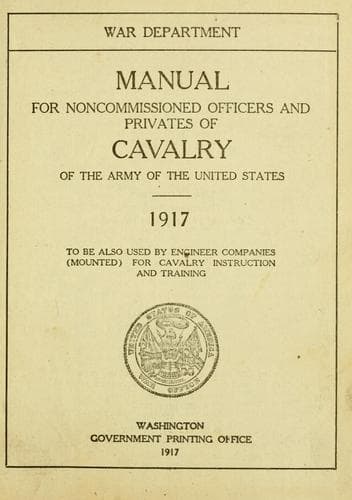
Manual for Noncommissioned Officers and Privates of Cavalry of the Army: of the United States 1917. To be also used by Engineer Companies (Mounted) for Cavalry Instruction and TrainingUnited States. War Department
History
Manual for Noncommissioned Officers and Privates of Cavalry of the Army: of the United States 1917. To be also used by Engineer Companies (Mounted) for Cavalry Instruction and Training
United States. War Department
United States. Army -- Handbooks, manuals, etc.
=65.= He will have the details for hoisting the flag at reveille and
lowering it at retreat, and for firing the reveille and retreat gun,
made in time for the proper performance of these duties. (See pars.
338, 344, 345, and 346.) He will see that the flags are kept in the
best condition possible, and that they are never handled except in the
proper performance of duty.
=66.= He may permit members of the guard while at the guardhouse to
remove their headdress, overcoats, and gloves; if they leave the
guardhouse for any purpose whatever, he will require that they be
properly equipped and armed according to the character of the service
in which engaged, or as directed by the commanding officer.
=67.= He will enter in the guard report a report of his tour of duty
and, on the completion of his tour, will present it to the officer of
the day. He will transmit with his report all passes turned in at the
post of the guard.
=68.= Whenever a prisoner is sent to the guardhouse or guard tent for
confinement he will cause him to be searched, and will, without
unnecessary delay, report the case to the officer of the day.
=69.= Under war conditions, if anyone is to be passed out of camp at
night, he will be sent to the commander of the guard, who will have
him passed beyond the sentinels.
=70.= The commander of the guard will detain at the guardhouse all
suspicious characters or parties attempting to pass a sentinel's post
without authority, reporting his action to the officer of the day, to
whom persons so arrested will be sent, if necessary.
=71.= He will inspect the guardrooms and cells, and the irons of such
prisoners as may be ironed, at least once during his tour, and at such
other times as he may deem necessary.
=72.= He will cause the corporals of the old and new reliefs to verify
together, immediately before each relief goes on post, the number of
prisoners who should then properly be at the guardhouse.
=73.= He will see that the sentences of prisoners under his charge are
executed strictly in accordance with the action of the reviewing
authority.
=74.= When no special prisoner guard has been detailed (par. 300), he
will, as far as practicable, assign as guards over working parties of
prisoners sentinels from posts guarded at night only.
=75.= The commander of the guard will inspect all meals sent to the
guardhouse and see that the quantity and quality of food are in
accordance with regulations.
=76.= At guard mounting he will report to the old officer of the day
all cases of prisoners whose terms of sentence expire on that day, and
also all cases of prisoners concerning whom no statement of charges
has been received. (See par. 241.)
=77.= The commander of the guard is responsible for the security of
the prisoners under the charge of his guard; he becomes responsible
for them after their number has been verified and they have been
turned over to the custody of his guard by the old guard or by the
prisoner guard or overseers.
Public-domain text, read in full here on John Shaqi.
Reviews
Reviews
No reviews yet
Be the first to share your thoughts on this work.
Elsewhere in the archive
Join the Discussion
Join the discussion
Sign in to leave a comment or review.
Sign InorCreate an account