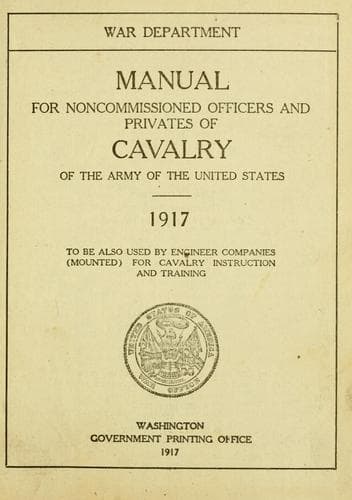
Manual for Noncommissioned Officers and Privates of Cavalry of the Army: of the United States 1917. To be also used by Engineer Companies (Mounted) for Cavalry Instruction and TrainingUnited States. War Department
History
Manual for Noncommissioned Officers and Privates of Cavalry of the Army: of the United States 1917. To be also used by Engineer Companies (Mounted) for Cavalry Instruction and Training
United States. War Department
United States. Army -- Handbooks, manuals, etc.
=78.= The prisoners will be verified and turned over to the new guard
without parading them, unless the commanding officer or the officer of
the day shall direct otherwise.
=79.= To receive the prisoners at the guardhouse when they have been
paraded and after they have been verified by the officers of the day,
the commander of the new guard directs his sergeant to form his guard
with an interval, and commands: 1. =Prisoners=, 2. =Right=, 3. =FACE=,
4. =Forward=, 5. =MARCH=. The prisoners having arrived opposite the
interval in the new guard, he commands: 1. =Prisoners=, 2. =HALT=, 3.
=Left=, 4. =FACE=, 5. =Right= (or =left=), 6. =DRESS=, 7. =FRONT=.
The prisoners dress on the line of the new guard.
=Section 5. Sergeant of the guard.=
=80.= The senior noncommissioned officer of the guard always acts as
sergeant of the guard and if there be no officer of the guard will
perform the duties prescribed for the commander of the guard.
=81.= The sergeant of the guard has general supervision over the other
noncommissioned officers and the musicians and privates of the guard,
and must be thoroughly familiar with all of their orders and duties.
=82.= He is directly responsible for the property under charge of the
guard and will see that it is properly cared for. He will make lists
of articles taken out by working parties and see that all such
articles are duly returned. If they are not, he will immediately
report the fact to the commander of the guard.
=83.= Immediately after guard mounting he will prepare duplicate lists
of the names of all noncommissioned officers, musicians, and privates
of the guard, showing the relief and post or duties of each. One list
will be handed as soon as possible to the commander of the guard; the
other will be retained by the sergeant.
=84.= He will see that all reliefs are turned out at the proper time,
and that the corporals thoroughly understand, and are prompt and
efficient in the discharge of their duties.
=85.= During the temporary absence from the guardhouse of the sergeant
of the guard, the next in rank of the noncommissioned officers will
perform his duties.
=86.= Should the corporal whose relief is on post be called away from
the guardhouse, the sergeant of the guard will designate a
noncommissioned officer to take the corporal's place until his return.
=87.= The sergeant of the guard is responsible at all times for the
proper police of the guardhouse or guard tent, including the ground
about them and the prison cells.
=88.= At =first sergeant's call= he will proceed to the adjutant's
office and obtain the guard report book.
=89.= When the national or regimental colors are taken from the stacks
of the color line, the color bearer and guard, or the sergeant of the
guard, unarmed, and two armed privates as a guard, will escort the
colors to the colonel's quarters, as prescribed for the color guard in
the drill regulations of the arm of the service to which the guard
belongs.
Public-domain text, read in full here on John Shaqi.
Reviews
Reviews
No reviews yet
Be the first to share your thoughts on this work.
Elsewhere in the archive
Join the Discussion
Join the discussion
Sign in to leave a comment or review.
Sign InorCreate an account