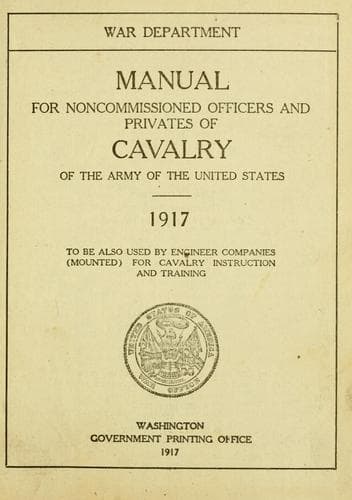
Manual for Noncommissioned Officers and Privates of Cavalry of the Army: of the United States 1917. To be also used by Engineer Companies (Mounted) for Cavalry Instruction and TrainingUnited States. War Department
History
Manual for Noncommissioned Officers and Privates of Cavalry of the Army: of the United States 1917. To be also used by Engineer Companies (Mounted) for Cavalry Instruction and Training
United States. War Department
United States. Army -- Handbooks, manuals, etc.
=90.= He will report to the commander of the guard any suspicious or
unusual occurrence that comes under his notice, will warn him of the
approach of any armed body, and will send to him all persons arrested
by the guard.
=91.= When the guard is turned out its formation will be as follows:
The senior noncommissioned officer, if commander of the guard, is on
the right of the right guide; if not commander of the guard, he is in
the line of file closers, in rear of the right four of the guard; the
next in rank is right guide; the next left guide; the others in the
line of file closers, usually each in rear of his relief; the field
music, with its left three paces to the right of the right guide. The
reliefs form in the same order as when the guard was first divided,
except that if the guard consists of dismounted Cavalry and Infantry,
the Cavalry forms on the left.
=92.= The sergeant forms the guard, calls the roll, and, if not in
command of the guard, reports to the commander of the guard as
prescribed in drill regulations for a first sergeant forming a troop
or company; the guard is not divided into platoons or sections, and,
except when the whole guard is formed prior to marching off, fours are
not counted.
=93.= The sergeant reports as follows: "=Sir, all present or
accounted for=," or "=Sir, (so-and-so) is absent="; or if the roll
call has been omitted, "=Sir, the guard is formed.=" Only men absent
without proper authority are reported absent. He then takes his place
without command.
=94.= At night the roll may be called by reliefs and numbers instead
of names; thus, the first relief being on post: =Second relief; No. 1;
No. 2; etc.; Third relief, Corporal; No. 1, etc.=
=95.= Calling the roll will be dispensed with in forming the guard
when it is turned out as a compliment, on the approach of an armed
body, or in any sudden emergency; but in such cases the roll may be
called before dismissing the guard. If the guard be turned out for an
officer entitled to inspect it, the roll will, unless he directs
otherwise, always be called before a report is made.
=96.= The sergeant of the guard has direct charge of the prisoners,
except during such time as they may be under the charge of the
prisoner guard or overseers, and is responsible to the commander of
the guard for their security.
=97.= He will carry the keys of the guardroom and cells, and will not
suffer them to leave his personal possession while he is at the
guardhouse, except as hereinafter provided. (Par. 99.) Should he leave
the guardhouse for any purpose he will turn the keys over to the
noncommissioned officer who takes his place. (Par. 85.)
=98.= He will count the knives, forks, etc., given to the prisoners
with their food, and see that none of these articles remain in their
possession. He will see that no forbidden articles of any kind are
conveyed to the prisoners.
Public-domain text, read in full here on John Shaqi.
Reviews
Reviews
No reviews yet
Be the first to share your thoughts on this work.
Elsewhere in the archive
Join the Discussion
Join the discussion
Sign in to leave a comment or review.
Sign InorCreate an account