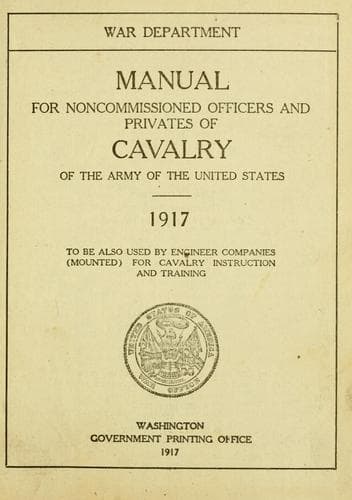
Manual for Noncommissioned Officers and Privates of Cavalry of the Army: of the United States 1917. To be also used by Engineer Companies (Mounted) for Cavalry Instruction and TrainingUnited States. War Department
History
Manual for Noncommissioned Officers and Privates of Cavalry of the Army: of the United States 1917. To be also used by Engineer Companies (Mounted) for Cavalry Instruction and Training
United States. War Department
United States. Army -- Handbooks, manuals, etc.
=99.= Prisoners when paraded with the guard are placed in line, in its
center. The sergeant, immediately before forming the guard, will turn
over his keys to the noncommissioned officer at the guardhouse. Having
formed the guard he will divide it into two nearly equal parts.
Indicating the point of division with his hand, he commands: 1. =Right
(or left)=, 2. =FACE=, 3. =Forward=, 4. =MARCH=, 5. =Guard=, 6.
=HALT=, 7. =Left (or right)=, 8. =FACE=.
If the first command be =right face=, the right half of the guard only
will execute the movements; if =left face=, the left half only will
execute them. The command =halt= is given when sufficient interval is
obtained to admit the prisoners. The doors of the guardroom and cells
are then opened by the noncommissioned officer having the keys. The
prisoners will file out under the supervision of the sergeant, the
noncommissioned officer, and sentinel on duty at the guardhouse, and
such other sentinels as may be necessary; they will form in line in
the interval between the two parts of the guard.
=100.= To return the prisoners to the guardroom and cells, the
sergeant commands: 1. =Prisoners=, 2. =Right (or left)=, 3. =FACE=, 4.
=Column right (or left)=, 5. =MARCH.=
The prisoners, under the same supervision as before, return to their
proper rooms or cells.
=101.= To close the guard, the sergeant commands: 1. =Left (or
right)=, 2. =FACE=, 3. =Forward=, 4. =MARCH=, 5. =Guard=, 6. =HALT=,
7. =Right= (or =left=), 8. =FACE.=
The left or right half only of the guard, as indicated, executes the
movement.
=102.= If there be but few prisoners, the sergeant may indicate the
point of division as above, and form the necessary interval by the
commands: 1. =Right= (or =left=) =step=, 2. =MARCH=, 3. =Guard=, 4.
=HALT=, and close the intervals by the commands: 1. =Left= (or
=right=) =step=, 2. =MARCH=, 3. =Guard=, 4. =HALT.=
=103.= If sentinels are numerous, reliefs may, at the discretion of
the commanding officer, be posted in detachments, and sergeants as
well as corporals required to relieve and post them.
=Section 6. Corporal of the Guard.=
=104.= A corporal of the guard receives and obeys orders from none but
noncommissioned officers of the guard senior to himself, the officers
of the guard, the officer of the day, and the commanding officer.
=105.= It is the duty of the corporal of the guard to post and relieve
sentinels and to instruct the members of his relief in their orders
and duties.
=106.= Immediately after the division of the guard into reliefs the
corporals will assign the members of their respective reliefs to posts
by number, and a soldier so assigned to his post will not be changed
to another during the same tour of guard duty unless by direction of
the commander of the guard or higher authority. Usually experienced
soldiers are placed over the arms of the guard and at remote and
responsible posts.
Public-domain text, read in full here on John Shaqi.
Reviews
Reviews
No reviews yet
Be the first to share your thoughts on this work.
Elsewhere in the archive
Join the Discussion
Join the discussion
Sign in to leave a comment or review.
Sign InorCreate an account