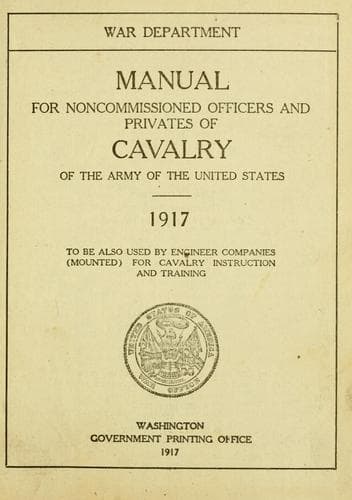
Manual for Noncommissioned Officers and Privates of Cavalry of the Army: of the United States 1917. To be also used by Engineer Companies (Mounted) for Cavalry Instruction and TrainingUnited States. War Department
History
Manual for Noncommissioned Officers and Privates of Cavalry of the Army: of the United States 1917. To be also used by Engineer Companies (Mounted) for Cavalry Instruction and Training
United States. War Department
United States. Army -- Handbooks, manuals, etc.
=107.= Each corporal will then make a list of the members of his
relief, including himself. This list will contain the number of the
relief, the name, the company, and the regiment of every member
thereof and the post to which each is assigned. The list will be made
in duplicate, one copy to be given to the sergeant of the guard as
soon as completed, the other to be retained by the corporal.
=108.= When directed by the commander of the guard, the corporal of
the first relief forms his relief, and then commands: =CALL OFF=.
Commencing on the right, the men call off alternately =rear= and
=front rank=, "one," "two," "three," "four," and so on; if in single
rank, they call off from right to left. The corporal then commands: 1.
=Right=, 2. =FACE=, 3. =Forward=, 4. =MARCH.=
The corporal marches on the left and near the rear file in order to
observe the march. The corporal of the old guard marches on the right
of the leading file, and takes command when the last one of the old
sentinels is relieved, changing places with the corporal of the new
guard.
=109.= When the relief arrives at six paces from a sentinel (see par.
168), the corporal halts it and commands, according to the number of
the post: =No. (----)=.
Both sentinels execute port arms or saber; the new sentinel approaches
the old, halting about one pace from him. (See par. 172.)
=110.= The corporals advance and place themselves, facing each other,
a little in advance of the new sentinel, the old corporal on his
right, the new corporal on his left, both at a right shoulder, and
observe that the old sentinel transmits correctly his instructions.
The following diagram will illustrate the positions taken:
[Illustration:
A
R -
| | | | | C| |D
| | | | -
B]
R is the relief; A, the new corporal; B, the old; C, the new sentinel;
D, the old.
=111.= The instructions relative to the post having been communicated,
the new corporal commands, =Post=; both sentinels then resume the
right shoulder, face toward the new corporal, and step back so as to
allow the relief to pass in front of them. The new corporal then
commands: "1. =Forward=, 2. =MARCH="; the old sentinel takes his place
in rear of the relief as it passes him, his piece in the same position
an those of the relief. The new sentinel stands fast at a right
shoulder until the relief has passed six paces beyond him, when he
walks his post. The corporals take their places as the relief passes
them.
=112.= Mounted sentinels are posted and relieved in accordance with
the same principles.
=113.= On the return of the old relief, the corporal of the new guard
falls out when the relief halts; the corporal of the old guard forms
his relief on the left of the old guard, salutes, and reports to the
commander of his guard: "=Sir, the relief is present="; or "=Sir,
(so-and-so) is absent=," and takes his place in the guard.
Public-domain text, read in full here on John Shaqi.
Reviews
Reviews
No reviews yet
Be the first to share your thoughts on this work.
Elsewhere in the archive
Join the Discussion
Join the discussion
Sign in to leave a comment or review.
Sign InorCreate an account