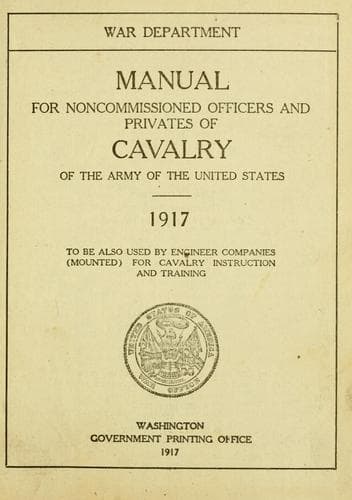
Manual for Noncommissioned Officers and Privates of Cavalry of the Army: of the United States 1917. To be also used by Engineer Companies (Mounted) for Cavalry Instruction and TrainingUnited States. War Department
History
Manual for Noncommissioned Officers and Privates of Cavalry of the Army: of the United States 1917. To be also used by Engineer Companies (Mounted) for Cavalry Instruction and Training
United States. War Department
United States. Army -- Handbooks, manuals, etc.
=114.= To post a relief other than that which is posted when the old
guard is relieved, its corporal commands:
1. =(Such) relief=, 2. =FALL IN=; and if arms are stacked, they are
taken at the proper commands.
The relief is formed facing to the front, with arms at an order, the
men place themselves according to the numbers of their respective
posts, viz, =two=, =four=, =six=, and so on, in the =front rank=, and
=one=, =three=, =five=, and so on, in the =rear rank=. The corporal,
standing about two paces in front of the center of his relief, then
commands: CALL OFF.
The men call off as prescribed. The corporal then commands: 1.
=Inspection=, 2. =ARMS=, 3. =Order=, 4. =ARMS=; faces the commander of
the guard, executes the rifle salute, reports: "=Sir, the relief is
present="; or "=Sir, (so-and-so) is absent="; he then takes his place
on the right at order arms.
=115.= When the commander of the guard directs the corporal, =Post
your relief=, the corporal salutes and posts his relief as prescribed
(Pars. 108 to 111); the corporal of the relief on post does not go
with the new relief, except when necessary to show the way.
=116.= To dismiss the old relief, it is halted and faced to the front
at the guardhouse by the corporal of the new relief, who then falls
out; the corporal of the old relief then steps in front of the relief
and dismisses it by the proper commands.
=117.= Should the pieces have been loaded before the relief was
posted, the corporal will, before dismissing the relief, see that no
cartridges are left in the chambers or magazines. The same rule
applies to sentinels over prisoners.
=118.= Each corporal will thoroughly acquaint himself with all the
special orders of every sentinel on his relief, and see that each
understands and correctly transmits such orders =in detail= to his
successor.
=119.= There should be at least one noncommissioned officer constantly
on the alert at the guardhouse, usually the corporal whose relief is
on post. This noncommissioned officer takes post near the entrance of
the guardhouse, and does not fall in with the guard when it is formed.
He will have his rifle constantly with him.
=120.= Whenever it becomes necessary for the corporal to leave his
post near the entrance of the guardhouse, he will notify the sergeant
of the guard, who will at once take his place, or designate another
noncommissioned officer to do so.
=121.= He will see that no person enters the guardhouse or guard tent,
or crosses the posts of the sentinels there posted without proper
authority.
=122.= Should any sentinel call for the corporal of the guard, the
corporal will, in every case, at once and quickly proceed to such
sentinel. He will notify the sergeant of the guard before leaving the
guardhouse.
=123.= He will at once report to the commander of the guard any
violation of regulations or any unusual occurrence which is reported
to him by a sentinel, or which comes to his notice in any other way.
Public-domain text, read in full here on John Shaqi.
Reviews
Reviews
No reviews yet
Be the first to share your thoughts on this work.
Elsewhere in the archive
Join the Discussion
Join the discussion
Sign in to leave a comment or review.
Sign InorCreate an account