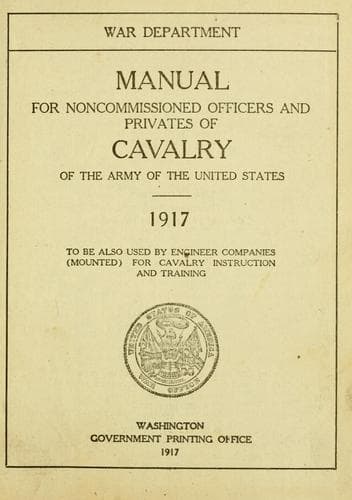
Manual for Noncommissioned Officers and Privates of Cavalry of the Army: of the United States 1917. To be also used by Engineer Companies (Mounted) for Cavalry Instruction and TrainingUnited States. War Department
History
Manual for Noncommissioned Officers and Privates of Cavalry of the Army: of the United States 1917. To be also used by Engineer Companies (Mounted) for Cavalry Instruction and Training
United States. War Department
United States. Army -- Handbooks, manuals, etc.
=124.= Should a sentinel call "=The Guard=," the corporal will
promptly notify the commander of the guard.
=125.= Should a sentinel call "=Relief=," the corporal will at once
proceed to the post of such sentinel, taking with him the man next for
duty on that post. If the sentinel is relieved for a short time only,
the corporal will again post him as soon as the necessity for his
relief ceases.
=126.= When the countersign is used, the corporal at the posting of
the relief during whose tour challenging is to begin gives the
countersign to the members of the relief, excepting those posted at
the guardhouse.
=127.= He will wake the corporal whose relief is next on post in time
for the latter to verify the prisoners, form his relief, and post it
at the proper hour.
=128.= Should the guard be turned out, each corporal will call his own
relief, and cause its members to fall in promptly.
=129.= Tents or bunks in the same vicinity will be designated for the
reliefs so that all the members of each relief may, if necessary, be
found and turned out by the corporal in the least time and with the
least confusion.
=130.= When challenged by a sentinel while posting his relief, the
corporal commands: 1. =Relief=, 2. =HALT=; to the sentinel's challenge
he answers "=Relief=," and at the order of the sentinel he advances
alone to give the countersign, or to be recognized. When the sentinel
says, "=Advance relief=," the corporal commands: 1. =Forward=, 2.
=MARCH.=
If to be relieved, the sentinel is then relieved as prescribed.
=131.= Between retreat and reveille, the corporal of the guard will
challenge all suspicious looking persons or parties he may observe,
first halting his patrol or relief, if either be with him. He will
advance them in the same manner that sentinels on post advance like
parties (Pars. 191 to 197), but if the route of a patrol is on a
continuous chain of sentinels, he should not challenge persons coming
near him unless he has reason to believe that they have eluded the
vigilance of sentinels.
=132.= Between retreat and reveille, whenever so ordered by an officer
entitled to inspect the guard, the corporal will call: "=Turn out the
guard=," announcing the title of the officer, and then, if not
otherwise ordered, he will salute and return to his post.
=133.= As a general rule he will advance parties approaching the guard
at night in the same manner that sentinels on post advance like
parties. Thus, the sentinel at the guardhouse challenges and repeats
the answer to the corporal, as prescribed hereafter (Par. 200); the
corporal, advancing at port arms, says: "=Advance (so-and-so) with the
countersign=," or "=to be recognized=," if there be no countersign
used; the countersign being correctly given, or the party being duly
recognized, the corporal says: "=Advance (so-and-so)=," repeating the
answer to the challenge of the sentinel.
Public-domain text, read in full here on John Shaqi.
Reviews
Reviews
No reviews yet
Be the first to share your thoughts on this work.
Elsewhere in the archive
Join the Discussion
Join the discussion
Sign in to leave a comment or review.
Sign InorCreate an account