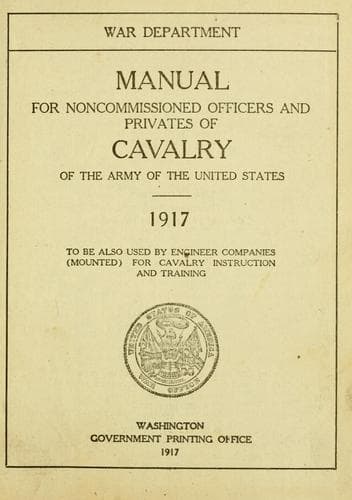
Manual for Noncommissioned Officers and Privates of Cavalry of the Army: of the United States 1917. To be also used by Engineer Companies (Mounted) for Cavalry Instruction and TrainingUnited States. War Department
History
Manual for Noncommissioned Officers and Privates of Cavalry of the Army: of the United States 1917. To be also used by Engineer Companies (Mounted) for Cavalry Instruction and Training
United States. War Department
United States. Army -- Handbooks, manuals, etc.
=134.= When officers of different rank approach the guardhouse from
different directions at the same time, the senior will be advanced
first, and will not be made to wait for his junior.
=135.= Out of ranks and under arms, the corporal salutes with the
rifle salute. He will salute all officers, whether by day or night.
=136.= The corporal will examine parties halted and detained by
sentinels, and, if he have reason to believe the parties have no
authority to cross sentinel's posts, will conduct them to the
commander of the guard.
=137.= The corporal of the guard will arrest all suspicious looking
characters prowling about the post or camp, all persons of a
disorderly character disturbing the peace, and all persons taken in
the act of committing crime against the Government on a military
reservation or post. All persons arrested by corporals of the guard or
by sentinels will at once be conducted to the commander of the guard
by the corporal.
=Section 7. Musicians of the guard.=
=138.= The musicians of the guard will sound calls as prescribed by
the commanding officer.
=139.= Should the guard be turned out for national or regimental
colors or standards, uncased, the field music of the guard will, when
the guard present arms, sound, "=To the color=" or "=To the
standard="; or, if for any person entitled thereto, the march,
flourishes, or ruffles, prescribed in paragraphs 375, 376, and 377, A.
R.
=Section 8. Orderlies and color sentinels.=
=140.= When so directed by the commanding officer, the officer who
inspects the guard at guard mounting will select from the members of
the new guard an orderly for the commanding officer and such number of
other orderlies and color sentinels as may be required.
=141.= For these positions the soldiers will be chosen who are most
correct in the performance of duty and in military bearing, neatest in
person and clothing, and whose arms and accouterments are in the best
condition. Clothing, arms, and equipments must conform to regulations.
If there is any doubt as to the relative qualifications of two or
more soldiers, the inspecting officer will cause them to fall out at
the guardhouse and to form in line in single rank. He will then, by
testing them in drill regulations, select the most proficient. The
commander of the guard will be notified of the selection.
=142.= When directed by the commander of the guard to fall out and
report an orderly will give his name, company, and regiment to the
sergeant of the guard, and, leaving his rifle in the arm rack in his
company quarters, will proceed at once to the officer to whom he is
assigned, reporting: "=Sir, Private ----, Company ----, reports as
orderly.="
=143.= If the orderly selected be a cavalryman, he will leave his
rifle in the arm rack of his troop quarters and report with his belt
on, but without side arms unless specially otherwise ordered.
Public-domain text, read in full here on John Shaqi.
Reviews
Reviews
No reviews yet
Be the first to share your thoughts on this work.
Elsewhere in the archive
Join the Discussion
Join the discussion
Sign in to leave a comment or review.
Sign InorCreate an account