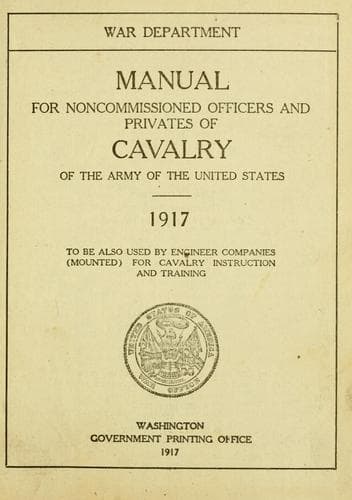
Manual for Noncommissioned Officers and Privates of Cavalry of the Army: of the United States 1917. To be also used by Engineer Companies (Mounted) for Cavalry Instruction and TrainingUnited States. War Department
History
Manual for Noncommissioned Officers and Privates of Cavalry of the Army: of the United States 1917. To be also used by Engineer Companies (Mounted) for Cavalry Instruction and Training
United States. War Department
United States. Army -- Handbooks, manuals, etc.
=144.= Orderlies, while on duty as such, are subject only to the
orders of the commanding officer and of the officers to whom they are
ordered to report.
=145.= When an orderly is ordered to carry a message, he will be
careful to deliver it exactly as it was given to him.
=146.= His tour of duty ends when he is relieved by the orderly
selected from the guard relieving his own.
=147.= Orderlies are members of the guard, and their name, company,
and regiment are entered on the guard report and lists of the guard.
=148.= If a color line is established, sufficient sentinels are placed
on the color line to guard the colors and stacks.
=149.= Color sentinels are posted only so long as the stacks are
formed. The commander of the guard will divide the time equally among
them.
=150.= When stacks are broken, the color sentinels may be permitted to
return to their respective companies. They are required to report in
person to the commander of the guard at reveille and retreat. They
will fall in with the guard, under arms, at guard mounting.
=151.= Color sentinels are not placed on the regular reliefs, nor are
their posts numbered. In calling for the corporal of the guard, they
call: "=Corporal of the guard. Color line.="
=152.= Officers or enlisted men passing the uncased colors will render
the prescribed salute. If the colors are on the stacks, the salute
will be made on crossing the color line or on passing the colors.
=153.= A sentinel placed over the colors will not permit them to be
moved except in the presence of an armed escort. Unless otherwise
ordered by the commanding officer, he will allow no one to touch them
but the color bearer.
He will not permit any soldier to take arms from the stacks or to
touch them except by order of an officer or noncommissioned officer of
the guard.
If any person passing the colors or crossing the color line fails to
salute the colors, the sentinel will caution him to do so, and if the
caution be not heeded he will call the corporal of the guard and
report the facts.
=Section 9. Privates of the Guard.=
=154.= Privates are assigned to reliefs by the commander of the guard,
and to posts usually by the corporal of their relief. They will not
change from one relief or post to another during the same tour of
guard duty unless by proper authority.
=Section 10. Orders for Sentinels.=
=155.= Orders for sentinels are of two classes: General orders and
special orders. General orders apply to all sentinels. Special orders
relate to particular posts and duties.
=156.= Sentinels will be required to memorize the following:
My general orders are:
=1. To take charge of this post and all Government property in view.=
=2. To walk my post in a military manner keeping always on the alert
and observing everything that takes place within sight or hearing.=
=3. To report all violations of orders I am instructed to enforce.=
=4. To repeat all calls from posts more distant from the guardhouse
than my own.=
Public-domain text, read in full here on John Shaqi.
Reviews
Reviews
No reviews yet
Be the first to share your thoughts on this work.
Elsewhere in the archive
Join the Discussion
Join the discussion
Sign in to leave a comment or review.
Sign InorCreate an account