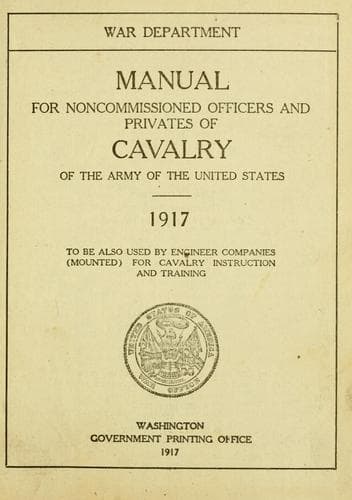
Manual for Noncommissioned Officers and Privates of Cavalry of the Army: of the United States 1917. To be also used by Engineer Companies (Mounted) for Cavalry Instruction and TrainingUnited States. War Department
History
Manual for Noncommissioned Officers and Privates of Cavalry of the Army: of the United States 1917. To be also used by Engineer Companies (Mounted) for Cavalry Instruction and Training
United States. War Department
United States. Army -- Handbooks, manuals, etc.
=5. To quit my post only when properly relieved.=
=6. To receive, obey, and pass on to the sentinel who relieves me all
orders from the commanding officer, officer of the day, and officers
and noncommissioned officers of the guard only.=
=7. To talk to no one except in line of duty.=
=8. In case of fire or disorder to give the alarm.=
=9. To allow no one to commit a nuisance on or near my post.=
=10. In any case not covered by instructions to call the corporal of
the guard.=
=11. To salute all officers, and all colors and standards not cased.=
=12. To be especially watchful at night, and, during the time for
challenging, to challenge all persons on or near my port and to allow
no one to pass without proper authority.=
REGULATIONS RELATING TO THE GENERAL ORDERS FOR SENTINELS.
No. 1: =To take charge of this post and all Government property in
view.=
=157.= All persons, of whatever rank in the service, are required to
observe respect toward sentinels and members of the guard when such
are in the performance of their duties.
=158.= A sentinel will at once report to the corporal of the guard
every unusual or suspicious occurrence noted.
=159.= He will arrest suspicious persons prowling about the post or
camp at any time, all parties to a disorder occurring on or near his
post, and all, except authorized persons, who attempt to enter the
camp at night, and will turn over to the corporal of the guard all
persons arrested.
=160.= The number, limits, and extent of his post will invariably
constitute part of the special orders of a sentinel on post. The
limits of his post should be so defined as to include every place to
which he is required to go in the performance of his duties.
No. 2: =To walk my post in a military manner, keeping always on the
alert and observing everything that takes place within sight or
hearing.=
=161.= A sentinel is not required to halt and change the position of
his rifle on arriving at the end of his post, nor to execute =to the
rear, march=, precisely as prescribed in the drill regulations, but
faces about while walking in the manner most convenient to him and at
any part of his post as may be best suited to the proper performance
of his duties. He carries his rifle on either shoulder, and in wet or
severe weather, when not in a sentry box, may carry it at a secure.
=162.= Sentinels when in sentry boxes stand at ease. Sentry boxes will
be used in wet weather only, or at other times when specially
authorized by the commanding officer.
=163.= In very hot weather, sentinels may be authorized to stand at
ease on their posts, provided they can effectively discharge their
duties in this position; but they will take advantage of this
privilege only on the express authority of the officer of the day or
the commander of the guard.
164. A mounted sentinel may dismount occasionally and lead the horse,
but will not relax his vigilance.
No. 3: =To report all violations of orders I am instructed to
enforce.=
Public-domain text, read in full here on John Shaqi.
Reviews
Reviews
No reviews yet
Be the first to share your thoughts on this work.
Elsewhere in the archive
Join the Discussion
Join the discussion
Sign in to leave a comment or review.
Sign InorCreate an account