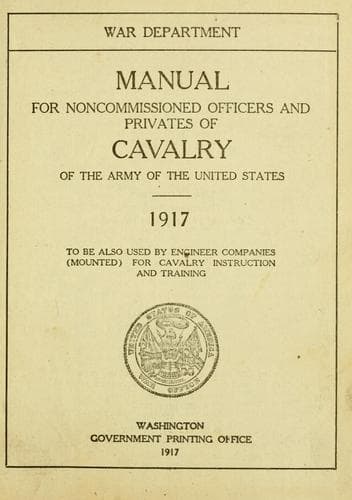
Manual for Noncommissioned Officers and Privates of Cavalry of the Army: of the United States 1917. To be also used by Engineer Companies (Mounted) for Cavalry Instruction and TrainingUnited States. War Department
History
Manual for Noncommissioned Officers and Privates of Cavalry of the Army: of the United States 1917. To be also used by Engineer Companies (Mounted) for Cavalry Instruction and Training
United States. War Department
United States. Army -- Handbooks, manuals, etc.
=165.= A sentinel will ordinarily report a violation of orders when he
is inspected or relieved, but if the case be urgent, he will call the
corporal of the guard, and also, if necessary, will arrest the
offender.
No. 4: =To repeat all calls from posts more distant from the
guardhouse than my own.=
=166.= To call the corporal of the guard for any purpose other than
relief, fire, or disorder (pars. 167 and 178), a sentinel will call,
"=Corporal of the guard, No. (--)=," adding the number of his post. In
no case will any sentinel call, "=Never mind the corporal="; nor will
the corporal heed such call if given.
No. 5: =To quit my post only when properly relieved.=
=167.= If relief becomes necessary, by reason of sickness or other
cause, a sentinel will call, "=Corporal of the guard, No. (----),
Relief=," giving the number of his post.
=168.= Whenever a sentinel is to be relieved, he will halt, and with
arms at a right shoulder, will face toward the relief, when it is 30
paces from him. He will come to a port arms with the new sentinel, and
in a low tone will transmit to him all the special orders relating to
the post and any other information which will assist him to better
perform his duties.
No. 6: =To receive, obey, and pass on to the sentinel who relieves me,
all orders from the commanding officer, officer of the day, and
officers and noncommissioned officers of the guard only.=
=169.= During his tour of duty a soldier is subject to the orders of
the commanding officer, officer of the day, and officers and
noncommissioned officers of the guard only; but any officer is
competent to investigate apparent violations of regulations by members
of the guard.
=170.= A sentinel will quit his piece on an explicit order from any
person from whom he lawfully receives orders while on post; under no
circumstances will he yield it to any other person. Unless necessity
therefor exists, no person will require a sentinel to quit his piece,
even to allow it to be inspected.
=171.= A sentinel will not divulge the countersign (Pars. 209 to 217)
to anyone except the sentinel who relieves him, or to a person from
whom he properly receives orders, on such person's verbal order given
personally. Privates of the guard will not use the countersign except
in the performance of their duties while posted as sentinels.
No. 7: =To talk to no one except in line of duty.=
Public-domain text, read in full here on John Shaqi.
Reviews
Reviews
No reviews yet
Be the first to share your thoughts on this work.
Elsewhere in the archive
Join the Discussion
Join the discussion
Sign in to leave a comment or review.
Sign InorCreate an account