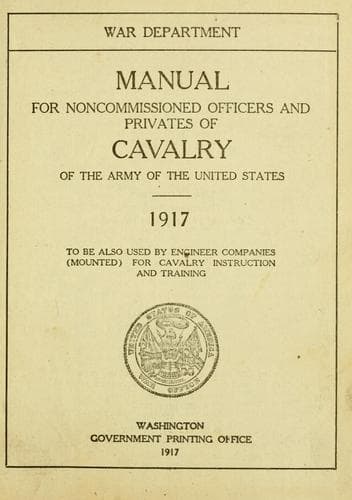
Manual for Noncommissioned Officers and Privates of Cavalry of the Army: of the United States 1917. To be also used by Engineer Companies (Mounted) for Cavalry Instruction and TrainingUnited States. War Department
History
Manual for Noncommissioned Officers and Privates of Cavalry of the Army: of the United States 1917. To be also used by Engineer Companies (Mounted) for Cavalry Instruction and Training
United States. War Department
United States. Army -- Handbooks, manuals, etc.
=172.= When calling for any purpose, challenging, or holding
communication with any person a dismounted sentinel armed with a rifle
or saber will take the position of port arms or saber. At night a
dismounted sentinel armed with a pistol takes the position of raised
pistol in challenging or holding communication. A mounted sentinel
does not ordinarily draw his weapon in the daytime when challenging or
holding conversation; but if drawn he holds it at advance rifle, raise
pistol, or port saber, according as he is armed with a rifle, pistol,
or saber. At night in challenging and holding conversation his weapon
is drawn and held as just prescribed, depending on whether he is armed
with a rifle, pistol, or saber.
No. 8: =In case of fire or disorder to give the alarm.=
=173.= In case of fire, a sentinel will call, "=Fire, No. (----)=,"
adding the number of his post; if possible, he will extinguish the
fire himself. In case of disorder he will call, "=The Guard, No.
(----)=," adding the number of his post. If the danger be great, he
will in either case discharge his piece before calling.
No. 11: =To salute all officers and all colors and standards not
cased.=
=174.= When not engaged in the performance of a specific duty, the
proper execution of which would prevent it, a member of the guard will
salute all officers who pass him. This rule applies at all hours of
the day or night, except in the case of mounted sentinels armed with a
rifle or pistol, or dismounted sentinels armed with a pistol, after
challenging. (See par. 181.)
=175.= Sentinels will salute as follows: A dismounted sentinel armed
with a rifle or saber salutes by presenting arms; if otherwise armed,
he salutes with the right hand.
A mounted sentinel, if armed with a saber and the saber be drawn,
salutes by presenting saber; otherwise he salutes in all cases with
the right hand.
=176.= To salute, a dismounted sentinel, with piece at a right
shoulder or saber at a carry, halts and faces toward the person to be
saluted when the latter arrives within 30 paces.
The limit within which individuals and insignia of rank can be readily
recognized is assumed to be about 30 paces, and therefore at this
distance cognizance is taken of the person or party to be saluted.
=177.= The salute is rendered at six paces; if the person to be
saluted does not arrive within that distance, then when he is nearest.
=178.= A sentinel in a sentry box, armed with a rifle, stands at
attention in the doorway on the approach of a person or party entitled
to salute, and salutes by presenting arms according to the foregoing
rules.
If armed with a saber, he stands at a carry and salutes as before.
=179.= A mounted sentinel on a regular post, halts, faces, and salutes
in accordance with the foregoing rules. If doing patrol duty, he
salutes, but does not halt unless spoken to.
Public-domain text, read in full here on John Shaqi.
Reviews
Reviews
No reviews yet
Be the first to share your thoughts on this work.
Elsewhere in the archive
Join the Discussion
Join the discussion
Sign in to leave a comment or review.
Sign InorCreate an account