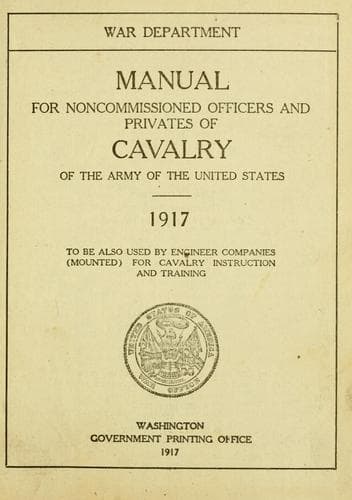
Manual for Noncommissioned Officers and Privates of Cavalry of the Army: of the United States 1917. To be also used by Engineer Companies (Mounted) for Cavalry Instruction and TrainingUnited States. War Department
History
Manual for Noncommissioned Officers and Privates of Cavalry of the Army: of the United States 1917. To be also used by Engineer Companies (Mounted) for Cavalry Instruction and Training
United States. War Department
United States. Army -- Handbooks, manuals, etc.
=180.= Sentinels salute, in accordance with the foregoing rules, all
persons and parties entitled to compliments from the guards (Pars.
224, 227, and 228); officers of the Army, Navy, and Marine Corps;
military and naval officers of foreign powers; officers of volunteers
and militia officers when in uniform.
=181.= A sentinel salutes as just prescribed when an officer comes on
his post; if the officer holds communication with the sentinel, the
sentinel again salutes when the officer leaves him.
During the hours when challenging is prescribed, the first salute is
given as soon as the officer has been duly recognized and advanced. A
mounted sentinel armed with a rifle or pistol, or a dismounted
sentinel armed with a pistol, does not salute after challenging.
He stands at advance rifle or raise pistol until the officer passes.
=182.= In case of the approach of an armed party of the guard, the
sentinel will halt when it is about 30 paces from him, facing toward
the party with his piece at the right shoulder. If not himself
relieved, he will, as the party passes, place himself so that the
party will pass in front of him; he resumes walking his post when the
party has reached six paces beyond him.
=183.= An officer is entitled to the compliments prescribed, whether
in uniform or not.
=184.= A sentinel in communication with an officer will not interrupt
the conversation to salute. In the case of seniors the officer will
salute, whereupon the sentinel will salute.
=185.= When the flag is being lowered at retreat, a sentinel on post
and in view of the flag will face the flag, and, at the first note of
the Star-Spangled Banner or =to the color= will come to a present
arms. At the sounding of the last note he will resume walking his
post.
No. 12: =To be especially watchful at night and during the time for
challenging, to challenge all persons on or near my post, and to allow
no one to pass without proper authority.=
=186.= During challenging hours, if a sentinel sees any person or
party on or near his post, he will advance rapidly along his post
toward such person or party and when within about 30 yards will
challenge sharply, "=Halt, who is there?=" He will place himself in
the best possible position to receive or, if necessary, to arrest the
person or party.
=187.= In case a mounted party be challenged, the sentinel will call,
"=Halt, Dismount. Who is there?="
=188.= The sentinel will permit only one of any party to approach him
for the purpose of giving the countersign (Pars. 200 to 217), or, if
no countersign be used, of being duly recognized. When this is done
the whole party is advanced, i. e., allowed to pass.
Public-domain text, read in full here on John Shaqi.
Reviews
Reviews
No reviews yet
Be the first to share your thoughts on this work.
Elsewhere in the archive
Join the Discussion
Join the discussion
Sign in to leave a comment or review.
Sign InorCreate an account