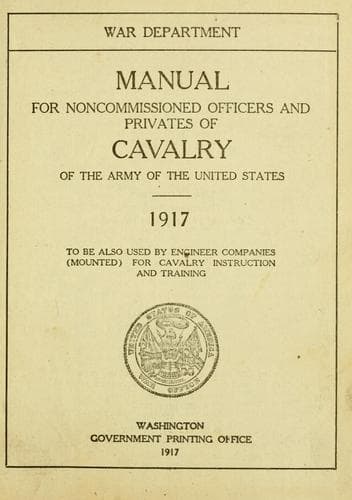
Manual for Noncommissioned Officers and Privates of Cavalry of the Army: of the United States 1917. To be also used by Engineer Companies (Mounted) for Cavalry Instruction and TrainingUnited States. War Department
History
Manual for Noncommissioned Officers and Privates of Cavalry of the Army: of the United States 1917. To be also used by Engineer Companies (Mounted) for Cavalry Instruction and Training
United States. War Department
United States. Army -- Handbooks, manuals, etc.
=189.= In all cases the sentinel must satisfy himself beyond a
reasonable doubt that the parties are what they represent themselves
to be and have a right to pass. If he is not satisfied, he must cause
them to stand and call the corporal of the guard. So, likewise, if he
have no authority to pass persons with the countersign, or when the
party has not the countersign, or gives an incorrect one.
=190.= A sentinel will not permit any person to approach so close as
to prevent the proper use of his own weapon before recognizing the
person or receiving the countersign.
=191.= When two or more persons approach in one party, the sentinel,
on receiving an answer that indicates that some one in the party has
the countersign, will say, "=Advance one with the countersign=," and
if the countersign is given correctly, will then say, "=Advance
(so-and-so)=," repeating the answer to his challenge. Thus if the
answer be "=Relief (friend with the countersign, patrol, etc.)=," the
sentinel will say, "=Advance one with the countersign="; then
"=Advance, relief (friends, patrol, etc.).="
=192.= If a person having the countersign approach alone, he is
advanced to give the countersign. Thus if the answer be "=Friend with
the countersign (or officer of the day, or etc.)=," the sentinel will
say, "=Advance, friend (or officer of the day, or etc.) with the
countersign="; then "=Advance, friend (or officer of the day, or
etc.).="
=193.= If two or more persons approach a sentinel's post from
different directions at the same time, all such persons are challenged
in turn and required to halt and to remain halted until advanced.
The senior is first advanced, in accordance with the foregoing rules.
=194.= If a party is already advanced and in communication with a
sentinel, the latter will challenge any other party that may approach;
if the party challenged be senior to the one already on his post, the
sentinel will advance the new party at once. The senior may allow him
to advance any or all of the other parties; otherwise the sentinel
will not advance any of them until the senior leaves him. He will then
advance the senior only of the remaining parties, and so on.
=195.= The following order of rank will govern a sentinel in advancing
different persons or parties approaching his post: Commanding
officers, officer of the day, officer of the guard, officers, patrols,
reliefs, noncommissioned officers of the guard in order of rank,
friends.
=196.= A sentinel will never allow himself to be surprised, nor permit
two parties to advance upon him at the same time.
=197.= If no countersign be used, the rules for challenging are the
same. The rules for advancing parties are modified only as follows:
Instead of saying "=Advance (so-and-so) with the countersign=," the
sentinel will say "=Advance (so-and-so) to be recognized.=" Upon
recognition he will say, "=Advance (so-and-so.)="
Public-domain text, read in full here on John Shaqi.
Reviews
Reviews
No reviews yet
Be the first to share your thoughts on this work.
Elsewhere in the archive
Join the Discussion
Join the discussion
Sign in to leave a comment or review.
Sign InorCreate an account