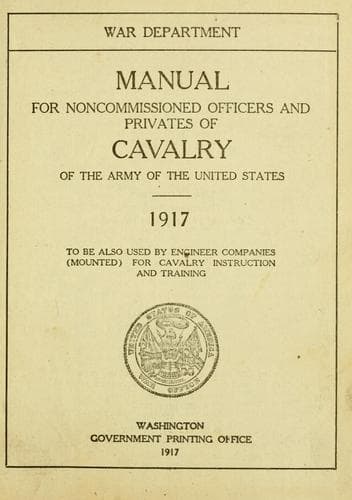
Manual for Noncommissioned Officers and Privates of Cavalry of the Army: of the United States 1917. To be also used by Engineer Companies (Mounted) for Cavalry Instruction and TrainingUnited States. War Department
History
Manual for Noncommissioned Officers and Privates of Cavalry of the Army: of the United States 1917. To be also used by Engineer Companies (Mounted) for Cavalry Instruction and Training
United States. War Department
United States. Army -- Handbooks, manuals, etc.
=198.= Answers to a sentinel's challenge intended to confuse or
mislead him are prohibited, but the use of such an answer as "=Friends
with the countersign=," is not to be understood as misleading, but as
the usual answer made by officers, patrols, etc., when the purpose of
their visit makes it desirable that their official capacity should not
be announced.
SPECIAL ORDERS FOR SENTINELS AT THE POST OF THE GUARD.
=199.= Sentinels posted at the guard will be required to memorize the
following:
=Between reveille and retreat to turn out the guard for all persons
designated by the commanding officer, for all colors or standards not
cased, and in time of war for all armed parties approaching my post,
except troops at drill and reliefs and detachments of the guard.=
=At night, after challenging any person or party, to advance no one
but call the corporal of the guard, repeating the answer to the
challenge.=
=200.= After receiving an answer to his challenge, the sentinel calls,
"=Corporal of the guard (so-and-so)=," repeating the answer to the
challenge.
He does not in such cases repeat the number of his post.
=201.= He remains in the position assumed in challenging until the
corporal has recognized or advanced the person or party challenged,
when he resumes walking his post, or, if the person or party be
entitled thereto, he salutes and, as soon as the salute has been
acknowledged, resumes walking his post.
=202.= The sentinel at the post of the guard will be notified by
direction of the commanding officer of the presence in camp or
garrison of persons entitled to the compliment. (Par. 224.)
=203.= The following examples illustrate the manner in which the
sentinel at the post of the guard will turn out the guard upon the
approach of persons or parties entitled to the compliment (Pars. 224,
227, and 228), "=Turn out the guard, commanding officer="; "=Turn out
the guard, governor of a Territory="; "=Turn out the guard, national
colors="; "=Turn out the guard, armed party="; etc.
At the approach of the new guard at guard mounting the sentinel will
call, "=Turn out the guard, armed party.="
=204.= Should the person named by the sentinel not desire the guard
formed, he will salute, whereupon the sentinel will call "=Never mind
the guard.="
=205.= After having called "=Turn out the guard=," the sentinel will
never call "=Never mind the guard=," on the approach of an armed
party.
=206.= Though the guard be already formed he will not fail to call,
"=Turn out the guard=," as required in his special orders, except that
the guard will not be turned out for any person while his senior is at
or coming to the post of the guard.
=207.= The sentinels at the post of the guard will warn the commander
of the approach of any armed body and of the presence in the vicinity
of all suspicious or disorderly persons.
Public-domain text, read in full here on John Shaqi.
Reviews
Reviews
No reviews yet
Be the first to share your thoughts on this work.
Elsewhere in the archive
Join the Discussion
Join the discussion
Sign in to leave a comment or review.
Sign InorCreate an account