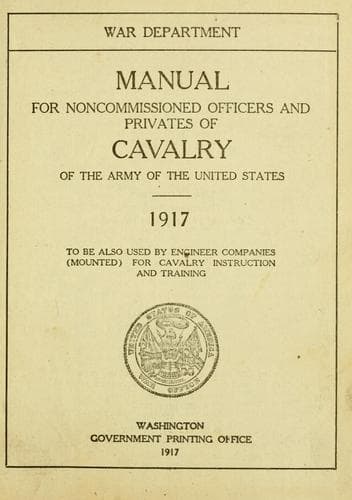
Manual for Noncommissioned Officers and Privates of Cavalry of the Army: of the United States 1917. To be also used by Engineer Companies (Mounted) for Cavalry Instruction and TrainingUnited States. War Department
History
Manual for Noncommissioned Officers and Privates of Cavalry of the Army: of the United States 1917. To be also used by Engineer Companies (Mounted) for Cavalry Instruction and Training
United States. War Department
United States. Army -- Handbooks, manuals, etc.
=208.= In case of fire or disorder in sight or hearing, the sentinel
at the guardhouse will call the corporal of the guard and report the
facts to him.
=Section 11. Countersigns and Paroles.=
=209.= _Seventy-seventh article of war._--Any person subject to
military law who makes known the parole or countersign to any person
not entitled to receive it according to the rules and discipline of
war, or gives a parole or countersign different from that which he
received, shall, if the offense be committed in time of war, suffer
death or such other punishment as a court-martial may direct. (See
Par. 171.)
=210.= The =countersign= is a word given daily from the principal
headquarters of a command to aid guards and sentinels in identifying
persons who may be authorized to pass at night.
It is given to such persons as may be authorized to pass and repass
sentinels' posts during the night, and to officers, noncommissioned
officers, and sentinels of the guard.
=211.= The =parole= is a word used as a check on the countersign in
order to obtain more accurate identification of persons. It is
imparted only to those who are entitled to inspect guards and to
commanders of guards.
The parole or countersign, or both, are sent sealed in the form of an
order to those entitled to them.
=212.= When the commander of the guard demands the parole, he will
advance and receive it as the corporal receives the countersign. (See
Par. 133.)
=213.= As the communications containing the parole and countersign
must at times be distributed by many orderlies, the parole intrusted
to many officers, and the countersign and parole to many officers and
sentinels, and as both the countersign and parole must, for large
commands, be prepared several days in advance, there is always danger
of their being lost or becoming known to persons who would make
improper use of them; moreover, a sentinel is too apt to take it for
granted that any person who gives the right countersign is what he
represents himself to be; hence for outpost duty there is greater
security in omitting the use of the countersign and parole, or in
using them with great caution. The chief reliance should be upon
personal recognition or identification of all persons claiming
authority to pass.
Persons whose sole means of identification is the countersign, or
concerning whose authority to pass there is a reasonable doubt, should
not be allowed to pass without the authority of the corporal of the
guard after proper investigation; the corporal will take to his next
superior any person about whom he is not competent to decide.
=214.= The =countersign= is usually the name of a battle; the parole,
that of a general or other distinguished person.
=215.= When they can not be communicated daily, a series of words for
some days in advance may be sent to posts or detachments that are to
use the same parole or countersign as the main body.
Public-domain text, read in full here on John Shaqi.
Reviews
Reviews
No reviews yet
Be the first to share your thoughts on this work.
Elsewhere in the archive
Join the Discussion
Join the discussion
Sign in to leave a comment or review.
Sign InorCreate an account