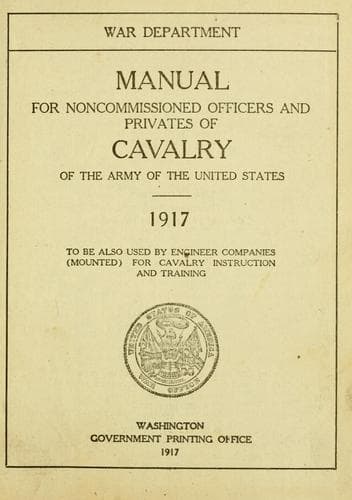
Manual for Noncommissioned Officers and Privates of Cavalry of the Army: of the United States 1917. To be also used by Engineer Companies (Mounted) for Cavalry Instruction and TrainingUnited States. War Department
History
Manual for Noncommissioned Officers and Privates of Cavalry of the Army: of the United States 1917. To be also used by Engineer Companies (Mounted) for Cavalry Instruction and Training
United States. War Department
United States. Army -- Handbooks, manuals, etc.
=216.= If the countersign be lost, or if a member of the guard deserts
with it, the commander on the spot will substitute another for it and
report the case at once to headquarters.
=217.= In addition to the countersign, use may be made of preconcerted
signals, such as striking the rifle with the hand or striking the
hands together a certain number of times as agreed upon. Such signals
may be used only by guards that occupy exposed points.
They are used before the countersign is given and must not be
communicated to anyone not entitled to know the countersign. Their use
is intended to prevent the surprise of a sentinel.
In the daytime signals such as raising a cap or a handkerchief in a
prearranged manner may be used by sentinels to communicate with the
guard or with each other.
=Section 12. Guard Patrols.=
=218.= A guard patrol consists of one or more men detailed for the
performance of some special service connected with guard duty.
=219.= If the patrol be required to go beyond the chain of sentinels,
the officer or noncommissioned officer in charge will be furnished
with the countersign and the outposts and sentinels warned.
=220.= If challenged by a sentinel, the patrol is halted by its
commander, and the noncommissioned officer accompanying it advances
alone and gives the countersign.
=Section 13. Watchmen.=
=221.= Enlisted men may be detailed as watchmen or as overseers over
prisoners, and as such will receive their orders and perform their
duties as the commanding officer may direct.
=Section 14. Compliments from Guards.=
=222.= The compliment from a guard consists in the guard turning out
and presenting arms. (See Par. 50.) No compliments will be paid
between retreat and reveille except as provided in paragraphs 361 and
362, nor will any person other than those named in paragraph 224
receive the compliment.
=223.= Though a guard does not turn out between retreat and reveille
as a matter of compliment, it may be turned out for inspection at any
time by a person entitled to inspect it.
Public-domain text, read in full here on John Shaqi.
Reviews
Reviews
No reviews yet
Be the first to share your thoughts on this work.
Elsewhere in the archive
Join the Discussion
Join the discussion
Sign in to leave a comment or review.
Sign InorCreate an account