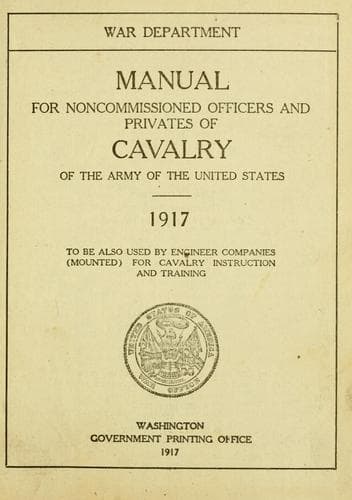
Manual for Noncommissioned Officers and Privates of Cavalry of the Army: of the United States 1917. To be also used by Engineer Companies (Mounted) for Cavalry Instruction and TrainingUnited States. War Department
History
Manual for Noncommissioned Officers and Privates of Cavalry of the Army: of the United States 1917. To be also used by Engineer Companies (Mounted) for Cavalry Instruction and Training
United States. War Department
United States. Army -- Handbooks, manuals, etc.
Many surgeons think that the method of binding a broken leg to the
well one, and of binding the arm to the body, is the best plan in the
field as being the quickest and one that serves the immediate purpose.
With wounds about the body, the chest, and abdomen you must not meddle
except to protect them when possible, without much handling, with the
materials of the packet.
FAINTING, SHOCK, HEAT EXHAUSTION.
The symptoms of fainting, shock, and heat exhaustion are very
similar. The face is pale, the skin cool and moist, the pulse is weak,
and generally the patient is unconscious. Keep the patient quiet,
resting on his back, with his head low. Loosen the clothing, but keep
the patient warm, and give stimulants (whisky, hot coffee, tea, etc.).
SUNSTROKE.
In the case of sunstroke the face is flushed, the skin is dry and very
hot, and the pulse is full and strong. In this case place the patient
in a cool spot, remove the clothing, and make every effort to lessen
the heat in the body by cold applications to the head and surface
generally. Do not, under any circumstances, give any stimulants or hot
drinks.
FREEZING AND FROSTBITE.
The part frozen, which looks white or bluish white, and is cold,
should be very slowly raised in temperature by brisk but careful
rubbing in a cool place, and never near a fire. Stimulants are to be
given cautiously when the patient can swallow, and followed by small
amounts of warm liquid nourishment. The object is to restore the
circulation of the blood and the natural warmth gradually and not
violently. Care and patience are necessary to do this.
RESUSCITATION OF THE APPARENTLY DROWNED.
In the instruction of the Army in First Aid the method of
resuscitation of the apparently drowned, as described by "Schaefer,"
will be taught instead of the "Sylvester Method," heretofore used. The
Schaefer method of artificial respiration is also applicable in cases
of electric shock, asphyxiation by gas, and of the failure of
respiration following concussion of the brain.
Being under water for four or five minutes is generally fatal, but an
effort to revive the apparently drowned should always be made, unless
it is known that the body has been under water for a very long time.
The attempt to revive the patient should not be delayed for the
purpose of removing his clothes or placing him in the ambulance. Begin
the procedure as soon as he is out of the water, on the shore or in
the boat. The first and most important thing is to start artificial
respiration without delay.
Public-domain text, read in full here on John Shaqi.
Reviews
Reviews
No reviews yet
Be the first to share your thoughts on this work.
Elsewhere in the archive
Join the Discussion
Join the discussion
Sign in to leave a comment or review.
Sign InorCreate an account