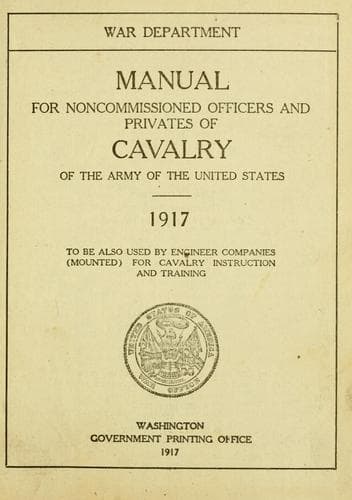
Manual for Noncommissioned Officers and Privates of Cavalry of the Army: of the United States 1917. To be also used by Engineer Companies (Mounted) for Cavalry Instruction and TrainingUnited States. War Department
History
Manual for Noncommissioned Officers and Privates of Cavalry of the Army: of the United States 1917. To be also used by Engineer Companies (Mounted) for Cavalry Instruction and Training
United States. War Department
United States. Army -- Handbooks, manuals, etc.
The Schaefer method is preferred because it can be carried out by one
person without assistance, and because its procedure is not exhausting
to the operator, thus permitting him, if required, to continue it for
one or two hours. When it is known that a person has been under water
for but a few minutes continue the artificial respiration for at least
one and a half to two hours before considering the case hopeless. Once
the patient has begun to breathe watch carefully to see that he does
not stop again. Should the breathing be very faint, or should he stop
breathing, assist him again with artificial respiration. After he
starts breathing do not lift him nor permit him to stand until the
breathing has become full and regular.
SCHAEFER METHOD.
As soon as the patient is removed from the water, turn him face to the
ground, clasp your hands under his waist, and raise the body so any
water may drain out of the air passages while the head remains low.
(Figure 9.)
[Illustration: FIG. 9.--Schaefer method of artificial respiration.
Inspiration.]
The patient is laid on his stomach, arms extended from his body beyond
his head, face turned to one side so that the mouth and nose do not
touch the ground. This position causes the tongue to fall forward of
its own weight and so prevents its falling back into the air passages.
Turning the head to one side prevents the face coming into contact
with mud or water during the operation. This position also
facilitates the removal from the mouth of foreign bodies, such as
tobacco, chewing gum, false teeth, etc., and favors the expulsion of
mucus, blood, vomitus, serum, or any liquid that may be in the air
passages.
[Illustration: FIG. 10--Schaefer method of artificial respiration.
Expiration.]
The operator kneels, straddles one or both of the patient's thighs,
and faces his head. Locating the lowest rib, the operator, with his
thumbs nearly parallel to his fingers, places his hands so that the
little finger curls over the twelfth rib. If the hands are on the
pelvic bones, the object of the work is defeated; hence the bones of
the pelvis are first located in order to avoid them. The hands must be
free from the pelvis and resting on the lowest rib. By operating on
the bare back it is easier to locate the lower ribs and avoid the
pelvis. The nearer the ends of the ribs the hands are placed without
sliding off the better. The hands are thus removed from the spine, the
fingers being nearly out of sight.
The fingers help some, but the chief pressure is exerted by the heels
(thenar and hypothenar eminences) of the hands, with the weight coming
straight from the shoulders. It is a waste of energy to bend the arms
at the elbows and shove in from the sides, because the muscles of the
back are stronger than the muscles of the arms.
Public-domain text, read in full here on John Shaqi.
Reviews
Reviews
No reviews yet
Be the first to share your thoughts on this work.
Elsewhere in the archive
Join the Discussion
Join the discussion
Sign in to leave a comment or review.
Sign InorCreate an account