Manual for the Solution of Military Ciphers — John Shaqi
Manual for the Solution of Military CiphersHitt, Parker
History
Manual for the Solution of Military Ciphers
Hitt, Parker
Ciphers; Cryptography
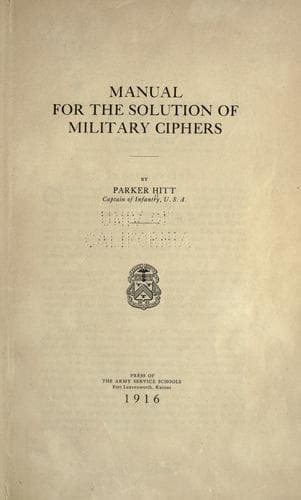
MANUAL
FOR THE SOLUTION OF
MILITARY CIPHERS
BY
PARKER HITT
Captain of Infantry, U. S. A.
PRESS OF
THE ARMY SERVICE SCHOOLS
Fort Leavenworth, Kansas
1916
MANUAL FOR THE SOLUTION
OF MILITARY CIPHERS
BY
PARKER HITT
Captain of Infantry, United States Army
INTRODUCTION
The history of war teems with occasions where the interception of
dispatches and orders written in plain language has resulted in
defeat and disaster for the force whose intentions thus became known
at once to the enemy. For this reason, prudent generals have used
cipher and code messages from time immemorial. The necessity for
exact expression of ideas practically excludes the use of codes for
military work although it is possible that a special tactical code
might be useful for preparation of tactical orders.
It is necessary therefore to fall back on ciphers for general military
work if secrecy of communication is to be fairly well assured. It
may as well be stated here that no practicable military cipher is
mathematically indecipherable if intercepted; the most that can be
expected is to delay for a longer or shorter time the deciphering of
the message by the interceptor.
The capture of messengers is no longer the only means available to
the enemy for gaining information as to the plans of a commander. All
radio messages sent out can be copied at hostile stations within radio
range. If the enemy can get a fine wire within one hundred feet of a
buzzer line or within thirty feet of a telegraph line, the message can
be copied by induction. Messages passing over commercial telegraph
lines, and even over military lines, can be copied by spies in the
offices. On telegraph lines of a permanent nature it is possible to
install high speed automatic sending and receiving machines and thus
prevent surreptitious copying of messages, but nothing but a secure
cipher will serve with other means of communication.
It is not alone the body of the message which should be in cipher. It
is equally important that, during transmission, the preamble, place
from, date, address and signature be enciphered; but this should
be done by the sending operator and these parts must, of course,
be deciphered by the receiving operator before delivery. A special
operators' cipher should be used for this purpose but it is difficult
to prescribe one that would be simple enough for the average operator,
fast and yet reasonably safe. Some form of rotary cipher machine
would seem to be best suited for this special purpose.
Public-domain text, read in full here on John Shaqi.
Reviews
Reviews
No reviews yet
Be the first to share your thoughts on this work.
Join the Discussion
Join the discussion
Sign in to leave a comment or review.
Sign InorCreate an account