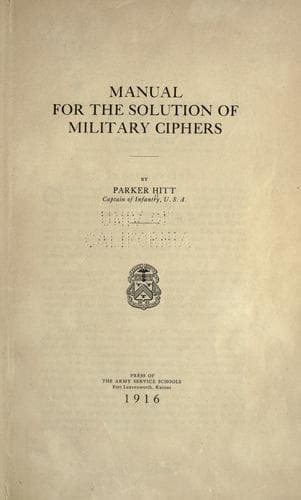
Manual for the Solution of Military Ciphers — John Shaqi
Manual for the Solution of Military CiphersHitt, Parker
History
Manual for the Solution of Military Ciphers
Hitt, Parker
Ciphers; Cryptography
The class and case are determined by the rules laid down later. The
space for remarks is to permit notation of any special features. When
the solution is completed, the date and hour are noted, the language
of text and key (if determined) are entered and a type number, to
identify it with other ciphers prepared by the same method (but not
necessarily the same key), is given to it. The file number is for
convenience in filing and in preparation of a card index.
The process of examination in an office with one examiner, one
stenographer and one clerk, might be as follows: On receipt of a
captured cipher with accompanying report, the stenographer makes four
copies of the cipher on the typewriter. The clerk and stenographer then
check the work. The stenographer then proceeds to fill out the first
column and first two lines of the second column of the record blank
from the report of the capturing officer, keeping the original cipher
and two copies with the record. He may also fill out the first seven
lines of the second column, if this data is on the captured cipher in
plain text. In the meantime the clerk is counting and setting down the
whole number of letters of the cipher and the occurrence of AEIOU,
LNRST, and JKQXZ, while the examining officer is looking over the
cipher for possible recurring groups of letters and underlining them
when found.
This work being completed, the examining officer is in a position,
ordinarily, to decide on the class of the cipher and he may have found
something in his examination which will lead him to the case under the
class. The clerk in this preliminary count should keep track of the
total occurrence of each of the fifteen check letters and not of the
three groups given above. This takes a little longer but when done,
the data for fifteen letters of the alphabet for a frequency table is
completed, leaving only eleven other letters, and in Spanish, but nine,
to be counted, in case it is necessary to prepare a frequency table.
If the examining officer decides the cipher to be of the transposition
class, no further work with frequency tables is necessary. The
clerk should proceed to count and set down the number of vowels in
each line and column and the examining officer should look for any
occurrence of the letter Q and try to connect it with U and another
vowel. The stenographer may be set to work putting the cipher into
rectangles of different dimensions. The clerk's work gives data for
possible rearrangement, for if the vowels are much out of proportion
at any point, they must be connected with the proper proportion of
consonants as a first step in rearrangement. Work with transposition
ciphers must necessarily include much of the fit and try method. The
details of this work are taken up later.
Public-domain text, read in full here on John Shaqi.
Reviews
Reviews
No reviews yet
Be the first to share your thoughts on this work.
Join the Discussion
Join the discussion
Sign in to leave a comment or review.
Sign InorCreate an account