Manual for the Solution of Military Ciphers — John Shaqi
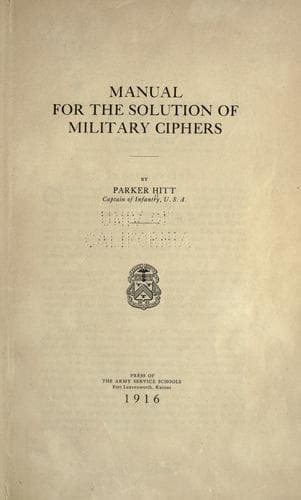
Manual for the Solution of Military CiphersHitt, Parker
History
Manual for the Solution of Military Ciphers
Hitt, Parker
Ciphers; Cryptography
If a cipher seems to be a substitution cipher, the examining officer
should look over the frequency of occurrence of each of the fifteen
letters counted. If some letters (it is of no importance at present
which ones) occur much more frequently than others and some occur
rarely or not at all, we may safely decide on Case 4, 5 or 6 and let
the clerk proceed to finish the frequency table for the message. On the
other hand, if all the fifteen letters examined occur with somewhere
near the same frequency--for example, the most common letter occurring
not over three or four times as often as the least common letter--we
may at once eliminate the first three cases and let the clerk proceed
to examine the cipher for recurring pairs and groups, counting the
intervening letters, so that the examining officer may decide whether
Case 7, or some more complicated case, should be chosen.
If something more complicated than Case 7 has been used and other
ciphers are on hand awaiting examination, the cipher should go into
the unsolved file to be worked on when other work permits, unless
the contents of the cipher are believed to be very important. Every
opportunity should be taken to clean up the unsolved file and, whenever
a message is solved, the methods should be tried, if applicable,
to everything remaining in the file.
The first few days or weeks after the establishment of an examining
office will be the most trying time. When solved ciphers begin to
pile up, the methods of the enemy will be more and more apparent and
it will often be possible to determine the method from knowledge of
the name of the sender and receiver.
When a cipher has been solved, the solution should be prepared in
triplicate and given the serial number of the cipher. Any parts which
are not clear, through errors in enciphering or in transmission,
should be underlined or otherwise made conspicuous, so that the head
of the Intelligence Section may note them and, possibly, from other
sources, supply the deficiency.
One of the copies of the cipher and report of examination, with a
copy of the solution, should be turned over at once to the head of
the Intelligence Section or to the Chief of Staff. The other copies
of the solution should be filed with the original cipher, the report
of examination, and all work done on the cipher.
Periodically, say once a week or even daily at the beginning of
active operations, there should be an interchange between all
examining offices of solved messages involving new methods used by
the enemy. All the examining offices will thus be kept in touch. It
may also be possible to assign certain hostile radio stations to each
examining office to prevent duplication of work.
CHAPTER IV
CLASSES OF CIPHERS
There are, in general, two classes of ciphers. These are the
transposition cipher and the substitution cipher.
Public-domain text, read in full here on John Shaqi.
Reviews
Reviews
No reviews yet
Be the first to share your thoughts on this work.
Join the Discussion
Join the discussion
Sign in to leave a comment or review.
Sign InorCreate an account