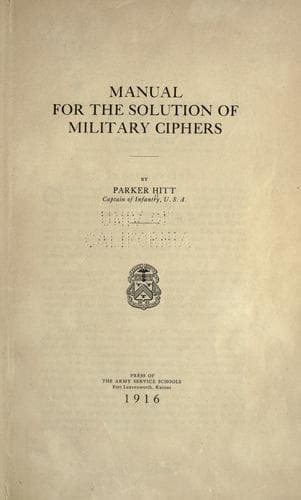
Manual for the Solution of Military Ciphers — John Shaqi
Manual for the Solution of Military CiphersHitt, Parker
History
Manual for the Solution of Military Ciphers
Hitt, Parker
Ciphers; Cryptography
Substitution ciphers may be made up of substituted letters, numerals,
conventional signs or combinations of all three; and furthermore,
for a single letter of the original text there may be substituted a
single letter, numeral or sign or two or more of each, or a whole
word or group of figures, combination of conventional signs, or
combinations of all three of these elements. Thus substitution ciphers
may vary from those of extreme simplicity to those whose complication
defies any ordinary method of analysis and whose solution requires
the possession of long messages and much time and study. Fortunately
the more difficult substitution ciphers are rarely used for military
purposes, on account of the time and care required for enciphering
and deciphering.
Transposition ciphers are limited to the characters of the original
text. These characters are rearranged singly, according to some
predetermined method or key (monoliteral transposition), or whole
words are similarly rearranged (route cipher).
There may also be a combination of transposition and substitution
methods in enciphering a message but in this case it will fall into
the substitution class on first determination and after solution
as a substitution cipher it must be handled as a transposition
cipher. Examples of this case will be given.
We may also find transposition or substitution methods applied to
words taken from a code book, or to numbers which represent these
words. Thus cipher methods blend into code work, for a code is,
after all, only a specialized substitution cipher.
We can now lay down the rules for determining whether any given cipher
belongs to the substitution class or to the transposition class.
Count the number of letters in the message, the number of vowels,
AEIOU, the number of the consonants, LNRST, and the number of the
consonants, JKQXZ.
If the text is English and the cipher is a transposition cipher,
this proportion will hold; vowels AEIOU constitute 40% of the whole;
consonants LNRST, 30% and consonants JKQXZ, 3%.
If the text be Spanish the proportions for a transposition cipher
will be: vowels AEIOU 45%, consonants LNRST, 30%; consonants JKQXZ, 2%.
If these proportions do not hold within 5%, one way or the other,
the cipher is certainly a substitution cipher. Note, however,
that often the end of a message is filled with letters like K, X,
Z to complete cipher words and it is best to neglect the last word
or words in making a count. Also, if the cipher be a long one, this
determination can safely be made by taking 100 or 200 consecutive
letters of the message, either from the beginning or, if nulls at
the beginning are suspected, from the interior of the message.
Public-domain text, read in full here on John Shaqi.
Reviews
Reviews
No reviews yet
Be the first to share your thoughts on this work.
Join the Discussion
Join the discussion
Sign in to leave a comment or review.
Sign InorCreate an account