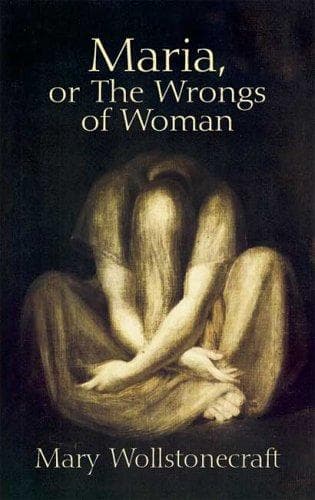
Maria; Or, The Wrongs of WomanWollstonecraft, Mary
General
Maria; Or, The Wrongs of Woman
Wollstonecraft, Mary
Autobiographical fiction; Feminist fiction; Women -- Fiction
“But, not to intrude on your patience, I retired to the track of land
which I had purchased in the country, and my time passed pleasantly
enough while I cut down the trees, built my house, and planted my
different crops. But winter and idleness came, and I longed for more
elegant society, to hear what was passing in the world, and to do
something better than vegetate with the animals that made a very
considerable part of my household. Consequently, I determined to
travel. Motion was a substitute for variety of objects; and, passing
over immense tracks of country, I exhausted my exuberant spirits,
without obtaining much experience. I every where saw industry the
fore-runner and not the consequence, of luxury; but this country,
everything being on an ample scale, did not afford those picturesque
views, which a certain degree of cultivation is necessary gradually to
produce. The eye wandered without an object to fix upon over
immeasureable plains, and lakes that seemed replenished by the ocean,
whilst eternal forests of small clustering trees, obstructed the
circulation of air, and embarrassed the path, without gratifying the
eye of taste. No cottage smiling in the waste, no travellers hailed us,
to give life to silent nature; or, if perchance we saw the print of a
footstep in our path, it was a dreadful warning to turn aside; and the
head ached as if assailed by the scalping knife. The Indians who
hovered on the skirts of the European settlements had only learned of
their neighbours to plunder, and they stole their guns from them to do
it with more safety.
“From the woods and back settlements, I returned to the towns, and
learned to eat and drink most valiantly; but without entering into
commerce (and I detested commerce) I found I could not live there; and,
growing heartily weary of the land of liberty and vulgar aristocracy,
seated on her bags of dollars, I resolved once more to visit Europe. I
wrote to a distant relation in England, with whom I had been educated,
mentioning the vessel in which I intended to sail. Arriving in London,
my senses were intoxicated. I ran from street to street, from theater
to theater, and the women of the town (again I must beg pardon for my
habitual frankness) appeared to me like angels.
“A week was spent in this thoughtless manner, when, returning very late
to the hotel in which I had lodged ever since my arrival, I was knocked
down in a private street, and hurried, in a state of insensibility,
into a coach, which brought me hither, and I only recovered my senses
to be treated like one who had lost them. My keepers are deaf to my
remonstrances and enquiries, yet assure me that my confinement shall
not last long. Still I cannot guess, though I weary myself with
conjectures, why I am confined, or in what part of England this house
is situated. I imagine sometimes that I hear the sea roar, and wished
myself again on the Atlantic, till I had a glimpse of you.”[5]
Public-domain text, read in full here on John Shaqi.
Reviews
Reviews
No reviews yet
Be the first to share your thoughts on this work.
Join the Discussion
Join the discussion
Sign in to leave a comment or review.
Sign InorCreate an account