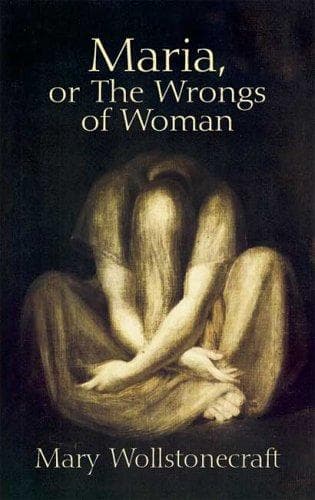
Maria; Or, The Wrongs of WomanWollstonecraft, Mary
General
Maria; Or, The Wrongs of Woman
Wollstonecraft, Mary
Autobiographical fiction; Feminist fiction; Women -- Fiction
“One of the gentlemen, whom I had frequently dined in company with,
while I was treated like a companion, met me in the street, and
enquired after my health. I seized the occasion, and began to describe
my situation; but he was in haste to join, at dinner, a select party of
choice spirits; therefore, without waiting to hear me, he impatiently
put a guinea into my hand, saying, ‘It was a pity such a sensible woman
should be in distress—he wished me well from his soul.’
“To another I wrote, stating my case, and requesting advice. He was an
advocate for unequivocal sincerity; and had often, in my presence,
descanted on the evils which arise in society from the despotism of
rank and riches.
“In reply, I received a long essay on the energy of the human mind,
with continual allusions to his own force of character. He added, ‘That
the woman who could write such a letter as I had sent him, could never
be in want of resources, were she to look into herself, and exert her
powers; misery was the consequence of indolence, and, as to my being
shut out from society, it was the lot of man to submit to certain
privations.’
“How often have I heard,” said Jemima, interrupting her narrative, “in
conversation, and read in books, that every person willing to work may
find employment? It is the vague assertion, I believe, of insensible
indolence, when it relates to men; but, with respect to women, I am
sure of its fallacy, unless they will submit to the most menial bodily
labour; and even to be employed at hard labour is out of the reach of
many, whose reputation misfortune or folly has tainted.
“How writers, professing to be friends to freedom, and the improvement
of morals, can assert that poverty is no evil, I cannot imagine.”
“No more can I,” interrupted Maria, “yet they even expatiate on the
peculiar happiness of indigence, though in what it can consist,
excepting in brutal rest, when a man can barely earn a subsistence, I
cannot imagine. The mind is necessarily imprisoned in its own little
tenement; and, fully occupied by keeping it in repair, has not time to
rove abroad for improvement. The book of knowledge is closely clasped,
against those who must fulfil their daily task of severe manual labour
or die; and curiosity, rarely excited by thought or information, seldom
moves on the stagnate lake of ignorance.”
“As far as I have been able to observe,” replied Jemima, “prejudices,
caught up by chance, are obstinately maintained by the poor, to the
exclusion of improvement; they have not time to reason or reflect to
any extent, or minds sufficiently exercised to adopt the principles of
action, which form perhaps the only basis of contentment in every
station.”[6]
[6] The copy which appears to have received the author’s last
corrections, ends at this place. [Godwin’s note]
Public-domain text, read in full here on John Shaqi.
Reviews
Reviews
No reviews yet
Be the first to share your thoughts on this work.
Join the Discussion
Join the discussion
Sign in to leave a comment or review.
Sign InorCreate an account