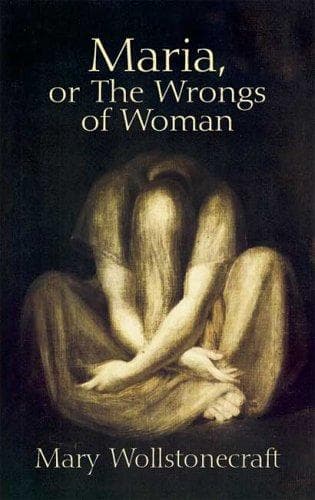
Maria; Or, The Wrongs of WomanWollstonecraft, Mary
General
Maria; Or, The Wrongs of Woman
Wollstonecraft, Mary
Autobiographical fiction; Feminist fiction; Women -- Fiction
A woman entered in the midst of these reflections, with a firm,
deliberate step, strongly marked features, and large black eyes, which
she fixed steadily on Maria’s, as if she designed to intimidate her,
saying at the same time “You had better sit down and eat your dinner,
than look at the clouds.”
“I have no appetite,” replied Maria, who had previously determined to
speak mildly; “why then should I eat?”
“But, in spite of that, you must and shall eat something. I have had
many ladies under my care, who have resolved to starve themselves; but,
soon or late, they gave up their intent, as they recovered their
senses.”
“Do you really think me mad?” asked Maria, meeting the searching glance
of her eye.
“Not just now. But what does that prove?—Only that you must be the more
carefully watched, for appearing at times so reasonable. You have not
touched a morsel since you entered the house.”—Maria sighed
intelligibly.—“Could any thing but madness produce such a disgust for
food?”
“Yes, grief; you would not ask the question if you knew what it was.”
The attendant shook her head; and a ghastly smile of desperate
fortitude served as a forcible reply, and made Maria pause, before she
added—“Yet I will take some refreshment: I mean not to die.—No; I will
preserve my senses; and convince even you, sooner than you are aware
of, that my intellects have never been disturbed, though the exertion
of them may have been suspended by some infernal drug.”
Doubt gathered still thicker on the brow of her guard, as she attempted
to convict her of mistake.
“Have patience!” exclaimed Maria, with a solemnity that inspired awe.
“My God! how have I been schooled into the practice!” A suffocation of
voice betrayed the agonizing emotions she was labouring to keep down;
and conquering a qualm of disgust, she calmly endeavoured to eat enough
to prove her docility, perpetually turning to the suspicious female,
whose observation she courted, while she was making the bed and
adjusting the room.
“Come to me often,” said Maria, with a tone of persuasion, in
consequence of a vague plan that she had hastily adopted, when, after
surveying this woman’s form and features, she felt convinced that she
had an understanding above the common standard, “and believe me mad,
till you are obliged to acknowledge the contrary.” The woman was no
fool, that is, she was superior to her class; nor had misery quite
petrified the life’s-blood of humanity, to which reflections on our own
misfortunes only give a more orderly course. The manner, rather than
the expostulations, of Maria made a slight suspicion dart into her mind
with corresponding sympathy, which various other avocations, and the
habit of banishing compunction, prevented her, for the present, from
examining more minutely.
Public-domain text, read in full here on John Shaqi.
Reviews
Reviews
No reviews yet
Be the first to share your thoughts on this work.
Join the Discussion
Join the discussion
Sign in to leave a comment or review.
Sign InorCreate an account