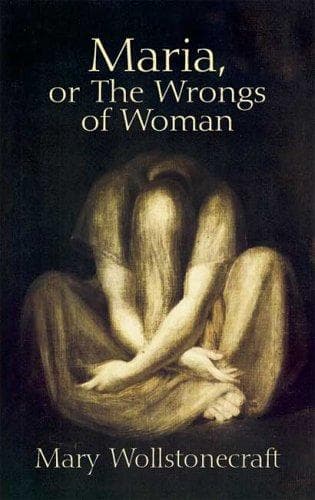
Maria; Or, The Wrongs of WomanWollstonecraft, Mary
General
Maria; Or, The Wrongs of Woman
Wollstonecraft, Mary
Autobiographical fiction; Feminist fiction; Women -- Fiction
“I snatched the letter with indescribable emotion. The purport of it
was to invite him to dinner, and to ridicule his chivalrous respect for
me. He assured him, ‘that every woman had her price, and, with gross
indecency, hinted, that he should be glad to have the duty of a husband
taken off his hands. These he termed _liberal sentiments_. He advised
him not to shock my romantic notions, but to attack my credulous
generosity, and weak pity; and concluded with requesting him to lend
him five hundred pounds for a month or six weeks.’ I read this letter
twice over; and the firm purpose it inspired, calmed the rising tumult
of my soul. I rose deliberately, requested Mr. S—— to wait a moment,
and instantly going into the counting-house, desired Mr. Venables to
return with me to the dining-parlour.
“He laid down his pen, and entered with me, without observing any
change in my countenance. I shut the door, and, giving him the letter,
simply asked, ‘whether he wrote it, or was it a forgery?’
“Nothing could equal his confusion. His friend’s eye met his, and he
muttered something about a joke—But I interrupted him—‘It is
sufficient—We part for ever.’
“I continued, with solemnity, ‘I have borne with your tyranny and
infidelities. I disdain to utter what I have borne with. I thought you
unprincipled, but not so decidedly vicious. I formed a tie, in the
sight of heaven—I have held it sacred; even when men, more conformable
to my taste, have made me feel—I despise all subterfuge!—that I was not
dead to love. Neglected by you, I have resolutely stifled the enticing
emotions, and respected the plighted faith you outraged. And you dare
now to insult me, by selling me to prostitution!—Yes—equally lost to
delicacy and principle—you dared sacrilegiously to barter the honour of
the mother of your child.’
“Then, turning to Mr. S——, I added, ‘I call on you, Sir, to witness,’
and I lifted my hands and eyes to heaven, ‘that, as solemnly as I took
his name, I now abjure it,’ I pulled off my ring, and put it on the
table; ‘and that I mean immediately to quit his house, never to enter
it more. I will provide for myself and child. I leave him as free as I
am determined to be myself—he shall be answerable for no debts of
mine.’
“Astonishment closed their lips, till Mr. Venables, gently pushing his
friend, with a forced smile, out of the room, nature for a moment
prevailed, and, appearing like himself, he turned round, burning with
rage, to me: but there was no terror in the frown, excepting when
contrasted with the malignant smile which preceded it. He bade me
‘leave the house at my peril; told me he despised my threats; I had no
resource; I could not swear the peace against him!—I was not afraid of
my life!—he had never struck me!’
“He threw the letter in the fire, which I had incautiously left in his
hands; and, quitting the room, locked the door on me.
Public-domain text, read in full here on John Shaqi.
Reviews
Reviews
No reviews yet
Be the first to share your thoughts on this work.
Elsewhere in the archive
Join the Discussion
Join the discussion
Sign in to leave a comment or review.
Sign InorCreate an account