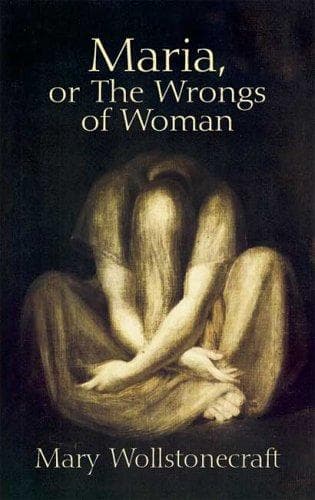
Maria; Or, The Wrongs of WomanWollstonecraft, Mary
General
Maria; Or, The Wrongs of Woman
Wollstonecraft, Mary
Autobiographical fiction; Feminist fiction; Women -- Fiction
There was one peculiarity in Maria’s mind: she was more anxious not to
deceive, than to guard against deception; and had rather trust without
sufficient reason, than be for ever the prey of doubt. Besides, what
are we, when the mind has, from reflection, a certain kind of
elevation, which exalts the contemplation above the little concerns of
prudence! We see what we wish, and make a world of our own—and, though
reality may sometimes open a door to misery, yet the moments of
happiness procured by the imagination, may, without a paradox, be
reckoned among the solid comforts of life. Maria now, imagining that
she had found a being of celestial mould—was happy,—nor was she
deceived.—He was then plastic in her impassioned hand—and reflected all
the sentiments which animated and warmed her.[12]
[12] Two and a half lines of dashes follow here in the original
[Publisher’s note].
CHAPTER 16
One morning confusion seemed to reign in the house, and Jemima came in
terror, to inform Maria, “that her master had left it, with a
determination, she was assured (and too many circumstances corroborated
the opinion, to leave a doubt of its truth) of never returning. I am
prepared then,” said Jemima, “to accompany you in your flight.”
Maria started up, her eyes darting towards the door, as if afraid that
some one should fasten it on her for ever.
Jemima continued, “I have perhaps no right now to expect the
performance of your promise; but on you it depends to reconcile me with
the human race.”
“But Darnford!”—exclaimed Maria, mournfully—sitting down again, and
crossing her arms—“I have no child to go to, and liberty has lost its
sweets.”
“I am much mistaken, if Darnford is not the cause of my master’s
flight—his keepers assure me, that they have promised to confine him
two days longer, and then he will be free—you cannot see him; but they
will give a letter to him the moment he is free.—In that inform him
where he may find you in London; fix on some hotel. Give me your
clothes; I will send them out of the house with mine, and we will slip
out at the garden-gate. Write your letter while I make these
arrangements, but lose no time!”
In an agitation of spirit, not to be calmed, Maria began to write to
Darnford. She called him by the sacred name of “husband,” and bade him
“hasten to her, to share her fortune, or she would return to him.”—An
hotel in the Adelphi was the place of rendezvous.
The letter was sealed and given in charge; and with light footsteps,
yet terrified at the sound of them, she descended, scarcely breathing,
and with an indistinct fear that she should never get out at the garden
gate. Jemima went first.
A being, with a visage that would have suited one possessed by a devil,
crossed the path, and seized Maria by the arm. Maria had no fear but of
being detained—“Who are you? what are you?” for the form was scarcely
human. “If you are made of flesh and blood,” his ghastly eyes glared on
her, “do not stop me!”
Public-domain text, read in full here on John Shaqi.
Reviews
Reviews
No reviews yet
Be the first to share your thoughts on this work.
Elsewhere in the archive
Join the Discussion
Join the discussion
Sign in to leave a comment or review.
Sign InorCreate an account