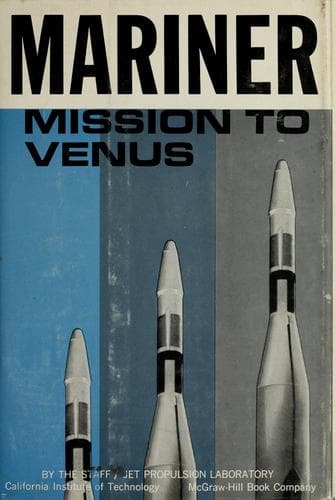
Mariner Mission to VenusJet Propulsion Laboratory (U.S.)
Science
Mariner Mission to Venus
Jet Propulsion Laboratory (U.S.)
Project Mariner (U.S.)
This was the beginning of Project MX-774, lineal ancestor of Atlas.
After captive testing at San Diego in 1947, three of the experimental
missiles were test-launched at White Sands Proving Ground in New Mexico.
The first flight failed at 6,200 feet after a premature engine burnout.
In 1947, the Air Force shelved the MX-774 project. However, this brief
program had proved the feasibility of three concepts later used in
Atlas: swiveling engines for directional control; lightweight,
pressurized airframe structures; and separable nose cones.
The Korean War stimulated the ICBM concept and, in 1951, a new MX-1593
contract was awarded to Convair to study ballistic and glide rockets. By
September, 1951, Convair was proposing a ballistic missile that would
incorporate some of the features of the MX-774 design. A plan for an
accelerated program was presented to the Air Force in 1953. After a year
of study, a full go-ahead for the project, now called Atlas, was given
in January, 1955.
The unit handling the Atlas program was set up as Convair Astronautics,
with J. R. Dempsey as president, on March 1, 1957.
The first Atlas test flight, in June of 1957, ended in destruction of
the missile when it went out of control. Following another abortive
attempt, the first fully successful flight of an Atlas missile was made
from Cape Canaveral on December 17, 1957.
The Atlas program was in full swing by 1958, when 14 test missions were
flown. The entire missile was orbited in December, 1958, as Project
Score. It carried the voice of President Eisenhower as a Christmas
message to the world. The Atlas missile system was accepted for field
operations by the Air Force in 1958.
Also in 1958, an Atlas achieved a new distance record, flying more than
9,000 miles down the Atlantic Missile Range, where it landed in the
Indian Ocean, off the South African coast.
Atlas has been modified for use by NASA as a space vehicle booster.
Known as the Atlas D, it has launched lunar probes, communications and
scientific Earth satellites, and manned space vehicles.
LOCKHEED: AGENA B
The Lockheed Agena B second-stage vehicle was mounted on top of the
Atlas booster in the launch of the Mariner spacecraft. The U. S. Air
Force had first asked Lockheed Missiles and Space Division, headed by L.
E. Root, to work on an advanced orbital vehicle for both military and
scientific applications in 1956. On October 29 of that year, Lockheed
was appointed prime weapon system contractor on the new Agena Project,
under the Air Force Ballistic Missile Division. In order to speed the
program, the Thor missile was used as the booster stage for the early
Agena flights. The Atlas was also utilized in later operations.
In August, 1957, the Air Force recommended that the program be
accelerated as much as possible. After Russia orbited Sputnik I in
October of 1957, a further speed-up was ordered.
Public-domain text, read in full here on John Shaqi.
Reviews
Reviews
No reviews yet
Be the first to share your thoughts on this work.
Join the Discussion
Join the discussion
Sign in to leave a comment or review.
Sign InorCreate an account