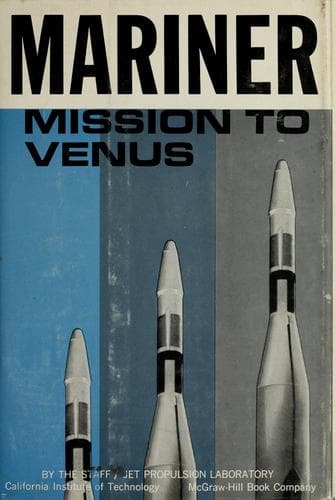
Mariner Mission to VenusJet Propulsion Laboratory (U.S.)
Science
Mariner Mission to Venus
Jet Propulsion Laboratory (U.S.)
Project Mariner (U.S.)
By 1947, the Corporal E, a new liquid-propellant research rocket, was
being fired. JPL was asked to convert it into a tactical weapon in 1949.
The Corporal E then became the first liquid-propellant
surface-to-surface guided missile developed by the United States or the
Western bloc of nations.
Because of the need for higher mobility and increased firing rate, JPL
later designed and developed the solid-propellant Sergeant—the nation’s
first “second-generation” weapon system. This inertially guided missile
was immune to electronic countermeasures by an enemy.
Meanwhile, JPL scientists had pioneered in the development of electronic
telemetering techniques, which permit an accurate monitoring of system
performance while missiles are in flight. By 1944, Dr. William H.
Pickering, a New Zealand born and Caltech-trained physicist who had
worked with Dr. Robert Millikan in cosmic ray research, had been placed
in charge of the telemetering effort at JPL. Pickering became Director
of the Laboratory in 1954.
Following the launching of Sputnik I, the Army-JPL team which had worked
on the Jupiter C missile to test nose cones, was assigned the
responsibility for putting the first United States satellite into orbit
as soon as possible. In just 83 days, a modified Jupiter C launch
vehicle was prepared, an instrumented payload was assembled, a network
of space communications stations was established, and Explorer I was
orbited on January 31, 1958. Explorer was an instrumented assembly
developed by JPL and the State University of Iowa. It discovered the
inner Van Allen radiation belt.
Subsequently, JPL worked with the Army on other projects to explore
space and to orbit satellites. Among these were Pioneer III, which
located the outer Van Allen Belt, and Pioneer IV, the first U. S. space
probe to reach Earth-escape velocity and to perform a lunar fly-by
mission.
GENERAL DYNAMICS: THE ATLAS
The launch vehicle for Mariner was an Atlas D booster with an Agena B
second stage. Historically, Atlas can be traced to October, 1954, when
the former Convair Corporation (later acquired by General Dynamics) was
invited to submit proposals for research and development of four missile
systems, including a 5,000-mile intercontinental weapon.
In January, 1946, Convair assigned K. J. Bossart to begin a study of two
proposed types of 5,000-mile missiles: one jet powered at subsonic
speeds, with wings for aerodynamic control; the other a supersonic,
ballistic (wingless and bullet-like), rocket-powered missile capable of
operating outside the Earth’s atmosphere.
[Illustration: _Photo courtesy of General Dynamics/Astro_
_Atlas missiles in assembly facility at General
Dynamics/Astronautics plant._]
Public-domain text, read in full here on John Shaqi.
Reviews
Reviews
No reviews yet
Be the first to share your thoughts on this work.
Join the Discussion
Join the discussion
Sign in to leave a comment or review.
Sign InorCreate an account